
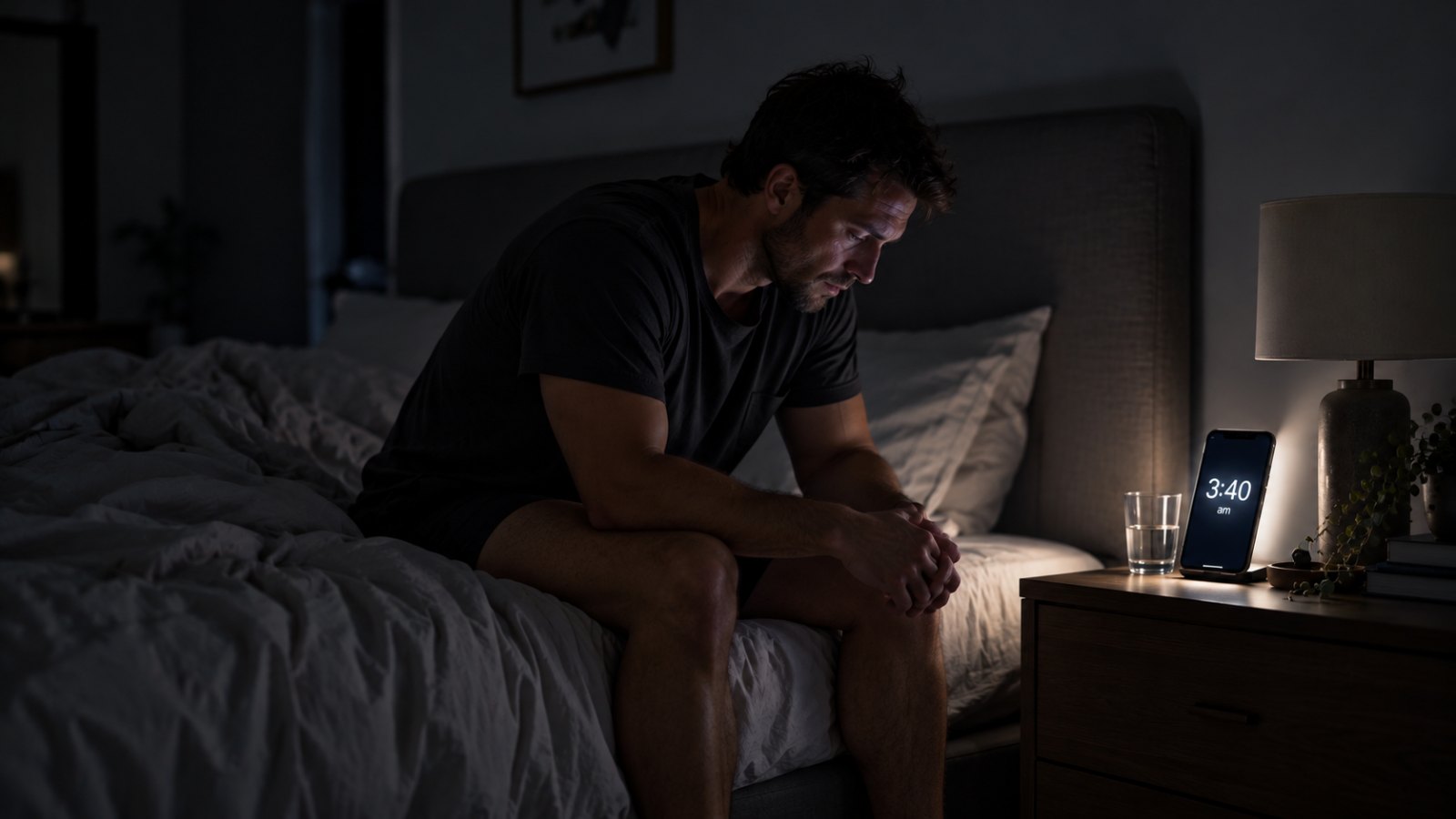
You went to bed at a decent hour. You slept, more or less, until the alarm. And you woke up feeling like you'd been hit by a bus. Coffee one, coffee two, a flat warm-up, and by 2 pm you're hunting the pantry.
Somewhere in the back of your head is a quiet question: is this just what getting older feels like, or is something actually wrong? That's what this post is about. First, what a good night actually looks like. Then what breaks it.
A night has a rhythm
Sleep isn't one thing. Through the night you cycle through three kinds, about every 90 minutes:
- Light sleep. The in-between. About half the night.
- Deep sleep. Slow, heavy, hard to wake from. This is when your body repairs: growth hormone, the repair hormone, comes out in its biggest pulse of the day. Most of it happens in the first half of the night.
- REM, or dream sleep. Your brain is busy: sorting memory, mood and the skills you practised that day. Most of it comes in the last two or three hours.
Running underneath, your hormones keep a timetable. Melatonin says it's night. Cortisol, the get-up hormone, should be at its lowest around midnight and climb from about 3 am, so you wake up with some fuel in the tank. Blood sugar should sit flat and quiet.
Below is a good night, then five ways it goes wrong. Tap through them. The dashed line is always the good night, so you can see what changed.
A good night: deep sleep early, dream sleep late, cortisol low until the early hours.
Illustrative, not one person's data. The shapes follow what the sleep studies show (references at the end): where deep sleep and REM sit, when the hormones rise and fall, and which part each problem breaks.
The thing to notice: none of the bad nights are short on hours in bed. Apart from the short night, every one of them is eight hours. What's missing is the rhythm. That's why "I slept eight hours" and "I feel terrible" can both be true.
Why sleep isn't fixing it
A few drinks
Alcohol is a sedative, so you fall asleep faster and sleep heavily for the first few hours. That's why a nightcap feels like it works. The catch is the second half. Across the studies, alcohol delays and cuts dream sleep and the second half of the night gets broken up as your body clears it.1 Your liver is busy with the alcohol rather than keeping your blood sugar topped up, the rebound kicks in, and you're awake at 3 am with your heart going. Two drinks at a barbecue is enough to see it.
A few extra kilos, and snoring
This is the one people miss. When you sleep, the muscles around your throat relax. Carry a bit more weight around the neck and the airway can narrow or close: obstructive sleep apnoea. Breathing stops or goes shallow for ten seconds or more, oxygen drops, and your brain jolts you just awake enough to breathe again. It can happen dozens of times an hour and you won't remember one of them. You just wake up wrecked.
Weight moves it a lot. In one long-running study, putting on 10% of your body weight predicted about 32% more breathing stops a night, and losing 10% predicted about 26% fewer.2 It runs both ways, too: bad sleep pushes up hunger, which makes the weight harder to shift.
A blocked nose: the bent septum
Not all snoring is weight. The septum, the wall between your nostrils, is a little off-centre in most people, and for plenty of them it's bent enough to narrow one side. Add a cold, hay fever or an old knock from sport and air can't get through the nose easily. You switch to breathing through your mouth, your jaw drops back, the throat narrows, and you snore. The sleep is lighter and you wake up with a dry mouth.
Nasal strips are the cheap first thing to try. The strip springs the sides of the nose open and makes it easier to breathe through it, so you're less likely to end up mouth-breathing. For snoring that comes from the nose, they help a lot of people. A saline rinse before bed helps if it's hay fever or a stuffy nose. Here's the line, though: in the studies, strips did little for real sleep apnoea.18 If the strips fix the snoring but you're still tired, or someone has seen you stop breathing, it's a GP visit. A badly bent septum can be fixed, and the GP can send you to an ENT.
One side of your nose always blocked, or it's worse lying on one side? Wear a strip for a week and ask whoever you sleep next to. If the snoring stops and you wake up fresher, that was your problem.
Apnoea doesn't always look like a loud snorer. In women it's more often tiredness, broken sleep, morning headaches or low mood, and the risk climbs after menopause. If that sounds like you, ask about it.
Stress
Cortisol is supposed to bottom out around midnight. When you're stressed, it doesn't. You lie down tired but wired, deep sleep is lighter, and you wake in the early hours with your brain already at work. When researchers cut people to four hours a night for six nights, their evening cortisol went up and their stress system ran hotter.5 Stress breaks sleep, and broken sleep makes you more stressed. That loop is why it drags on.
Blood sugar
A big, sweet dinner late in the evening sends blood sugar up as you're trying to drop off. Insulin pushes it back down, and while insulin is high, your growth hormone pulse is smaller. If it overshoots, blood sugar dips in the early hours and your body answers with adrenaline and cortisol to bring it back up. That's the hot, heart-racing 2 am wake-up. People who eat more sugar and less fibre get less deep sleep and more wake-ups through the night.7
It goes the other way too. Six nights of short sleep made healthy young men handle sugar worse, much like people decades older.5 Two short nights pushed hunger up about 24%, mostly for sweet and starchy food.6 Bad sleep makes you want the exact food that makes the next night worse.
Short nights, late coffee
Your body protects deep sleep, so it comes first even on a short night. Dream sleep sits at the back end. Cut two hours off the morning and you don't lose a fair share of everything: you lose most of your REM. Coffee doesn't help either. A strong dose six hours before bed still cut sleep by over an hour, and people didn't notice it.3 Pulling the studies together, a coffee wants about 9 hours before bed and a pre-workout about 13.4
And sleeping in on the weekend doesn't fully pay it back. In a study that copied the work-week and weekend pattern, the weekend lie-ins didn't stop the blood-sugar damage from the short weeknights.16
Is it just getting older?
Partly. Sleep does change with age. Across 65 studies of healthy people, adults get less deep sleep, a little less sleep overall and more wake-ups as the decades go on.8 The biggest drop in deep sleep happens earlier than you'd think, between your twenties and your forties, and it takes some of your growth hormone with it.9 After 60, most of it levels off.
But here's the useful bit. In that same research, when people with sleep apnoea and other problems were screened out, sleep held up better with age.8 A lot of what gets called "getting older" is actually something you can fix: a few kilos, a few drinks, a stressful job, a body changing through perimenopause. Waking up more often is normal. Waking up wrecked every day is not.
Normal with age
- Waking once or twice in the night, then dropping back off
- Getting sleepy and waking up a bit earlier than you used to
- Lighter sleep, easier to wake
- Needing a slower start after a big week or a late night
- A bad night after drinks, travel or a stressful day, then back to normal
Get it checked
- Snoring or gasping. Loud snoring, choking, or your partner sees you stop breathing.
- Nodding off in the day. At your desk, on the couch by 8 pm, at the lights in the car.
- Tired for weeks. More than a few weeks of it, despite 7 to 9 hours in bed.
- Low iron. Pale, breathless on the stairs, heavy periods. Common in women who train.
- Thyroid. Always cold, dry skin, weight creeping up for no reason.
- Perimenopause. Night sweats, hot flushes, new wake-ups in your 40s or 50s.
- Everything else. Up to wee twice or more a night, morning headaches, low mood that won't lift.
What to ask your GP for: a blood test (iron, thyroid and blood sugar are the usual three) and, if there's snoring or daytime sleepiness, whether you need a sleep study. Many can now be done at home.
What it does to your training
You can grind through a session on a bad night. But the numbers are clear that it costs you, and it costs you more than you feel.
Two more things worth knowing. Short sleep makes the same workout feel harder, and it makes you hungrier, so a run of bad nights shows up in your training and your nutrition at the same time. And you'll see "a week of short sleep drops testosterone 10 to 15%" all over the internet. That came from one small study of ten young men.13 When researchers later pooled 18 studies, a few short nights didn't clearly move it; staying up all night did.14 Treat it as a maybe. The performance numbers above are the solid ones.
Still come. Go a little lighter, keep the skill work, skip the max attempt and tell your coach. A morning session after a rough night is fine. A heavy evening session after three of them is when people get hurt.
Get the rhythm back
Most adults need 7 to 9 hours.17 But it's the rhythm you're protecting, so the fixes are about timing as much as hours.
- Same alarm, seven daysYour wake-up time sets your whole clock. Keep weekends within an hour of weekdays. Lie-ins don't pay the debt back.
- Daylight first thingTen minutes outside, early. It sets tonight's melatonin. After a 5 am class, the walk to the car counts.
- Coffee 9 hours out, pre-workout 13So if lights out is 9 pm, the last coffee is about midday and pre-workout is a morning-only thing.
- Last drink 4 hours before bedOr better, keep drinks for the nights before a rest day. Two in a row is where it really adds up.
- Dinner 3 hours before bed, built rightProtein, veg and slow carbs. Not a late sugar load, and not starving either.
- A 45-minute wind-downLights low, screens off, tomorrow's list written so your brain can let it go. Cool, dark room.
- Train when it suits youEvening training doesn't wreck sleep. Just finish hard sessions an hour or more before bed.15
- Snore? Open the nose, then get it looked atBlocked nose: try nasal strips for a week. Still snoring or still tired: see the GP. If there's weight to lose, 10% is a lot fewer breathing stops.
Here's how that plays out for you. Pick your alarm and how much sleep you need, and work back from there.
Alarm at 4:30 for the 5 am class? Lights out is 8:45 pm. That isn't early. It's bedtime.
If that looks impossible, don't try to move everything at once. Pick the one that's furthest off (for most people it's the drinks or the coffee) and fix that for two weeks. Then the next one.
Get the timing right first. If you've done that for a month and you still wake up wrecked, that's not age. That's a GP visit.
The research
- Ebrahim IO, Shapiro CM, Williams AJ, Fenwick PB. Alcohol and sleep I: effects on normal sleep. Alcohol Clin Exp Res 2013;37(4):539–549.
- Peppard PE, Young T, Palta M, Dempsey J, Skatrud J. Longitudinal study of moderate weight change and sleep-disordered breathing. JAMA 2000;284(23):3015–3021.
- Drake C, Roehrs T, Shambroom J, Roth T. Caffeine effects on sleep taken 0, 3, or 6 hours before going to bed. J Clin Sleep Med 2013;9(11):1195–1200.
- Gardiner C, Weakley J, Burke LM, et al. The effect of caffeine on subsequent sleep: a systematic review and meta-analysis. Sleep Med Rev 2023;69:101764.
- Spiegel K, Leproult R, Van Cauter E. Impact of sleep debt on metabolic and endocrine function. Lancet 1999;354:1435–1439.
- Spiegel K, Tasali E, Penev P, Van Cauter E. Sleep curtailment in healthy young men is associated with decreased leptin levels, elevated ghrelin levels, and increased hunger and appetite. Ann Intern Med 2004;141(11):846–850.
- St-Onge MP, Roberts A, Shechter A, Choudhury AR. Fiber and saturated fat are associated with sleep arousals and slow wave sleep. J Clin Sleep Med 2016;12(1):19–24.
- Ohayon MM, Carskadon MA, Guilleminault C, Vitiello MV. Meta-analysis of quantitative sleep parameters from childhood to old age in healthy individuals. Sleep 2004;27(7):1255–1273.
- Van Cauter E, Leproult R, Plat L. Age-related changes in slow wave sleep and REM sleep and relationship with growth hormone and cortisol levels in healthy men. JAMA 2000;284(7):861–868.
- Craven J, McCartney D, Desbrow B, et al. Effects of acute sleep loss on physical performance: a systematic and meta-analytical review. Sports Med 2022;52(11):2669–2690.
- Mah CD, Mah KE, Kezirian EJ, Dement WC. The effects of sleep extension on the athletic performance of collegiate basketball players. Sleep 2011;34(7):943–950.
- Milewski MD, Skaggs DL, Bishop GA, et al. Chronic lack of sleep is associated with increased sports injuries in adolescent athletes. J Pediatr Orthop 2014;34(2):129–133.
- Leproult R, Van Cauter E. Effect of 1 week of sleep restriction on testosterone levels in young healthy men. JAMA 2011;305(21):2173–2174.
- Su L, Zhang S, Zhu J, Wu J, Jiao Y. Effect of partial and total sleep deprivation on serum testosterone in healthy males: a systematic review and meta-analysis. Sleep Med 2021;88:267–273.
- Stutz J, Eiholzer R, Spengler CM. Effects of evening exercise on sleep in healthy participants: a systematic review and meta-analysis. Sports Med 2019;49(2):269–287.
- Depner CM, Melanson EL, Eckel RH, et al. Ad libitum weekend recovery sleep fails to prevent metabolic dysregulation during a repeating pattern of insufficient sleep and weekend recovery sleep. Curr Biol 2019;29(6):957–967.
- Hirshkowitz M, Whiton K, Albert SM, et al. National Sleep Foundation's sleep time duration recommendations. Sleep Health 2015;1(1):40–43.
- Camacho M, Malu OO, Kram YA, et al. Nasal dilators (Breathe Right strips and NoZovent) for snoring and OSA: a systematic review and meta-analysis. Pulm Med 2016;2016:4841310.