
This is a week of Fuel Rx
Nobody walks into class and makes up the workout. It's on the whiteboard, written by a coach, scaled to you. Fuel Rx is the same thing for your food. Here's a real week from the program, the first week of December. Then tap Winging it to see the week most people are running instead.
Your week
| Mon | Tue | Wed | Thu | Fri | Sat | Sun |
|---|
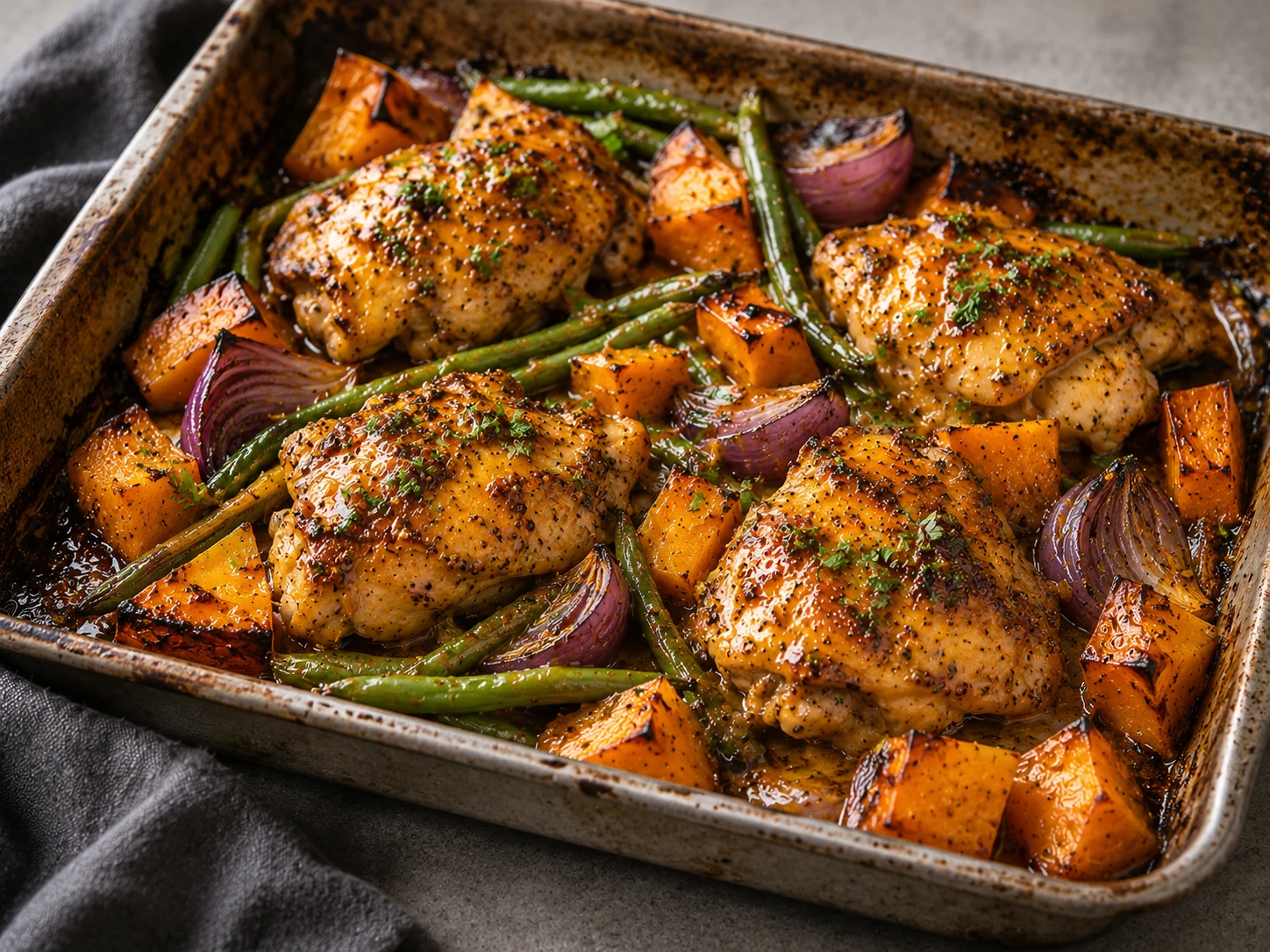
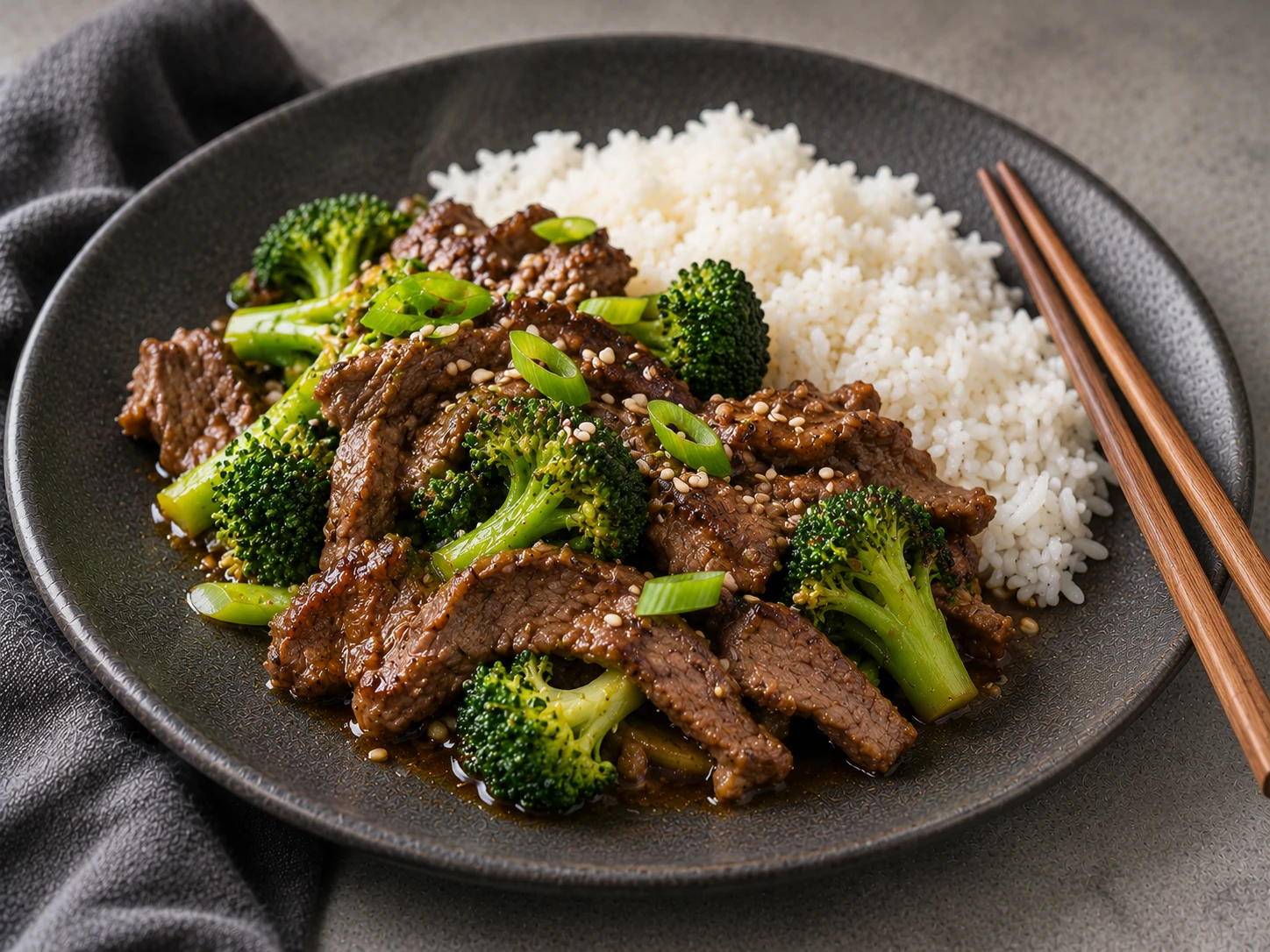
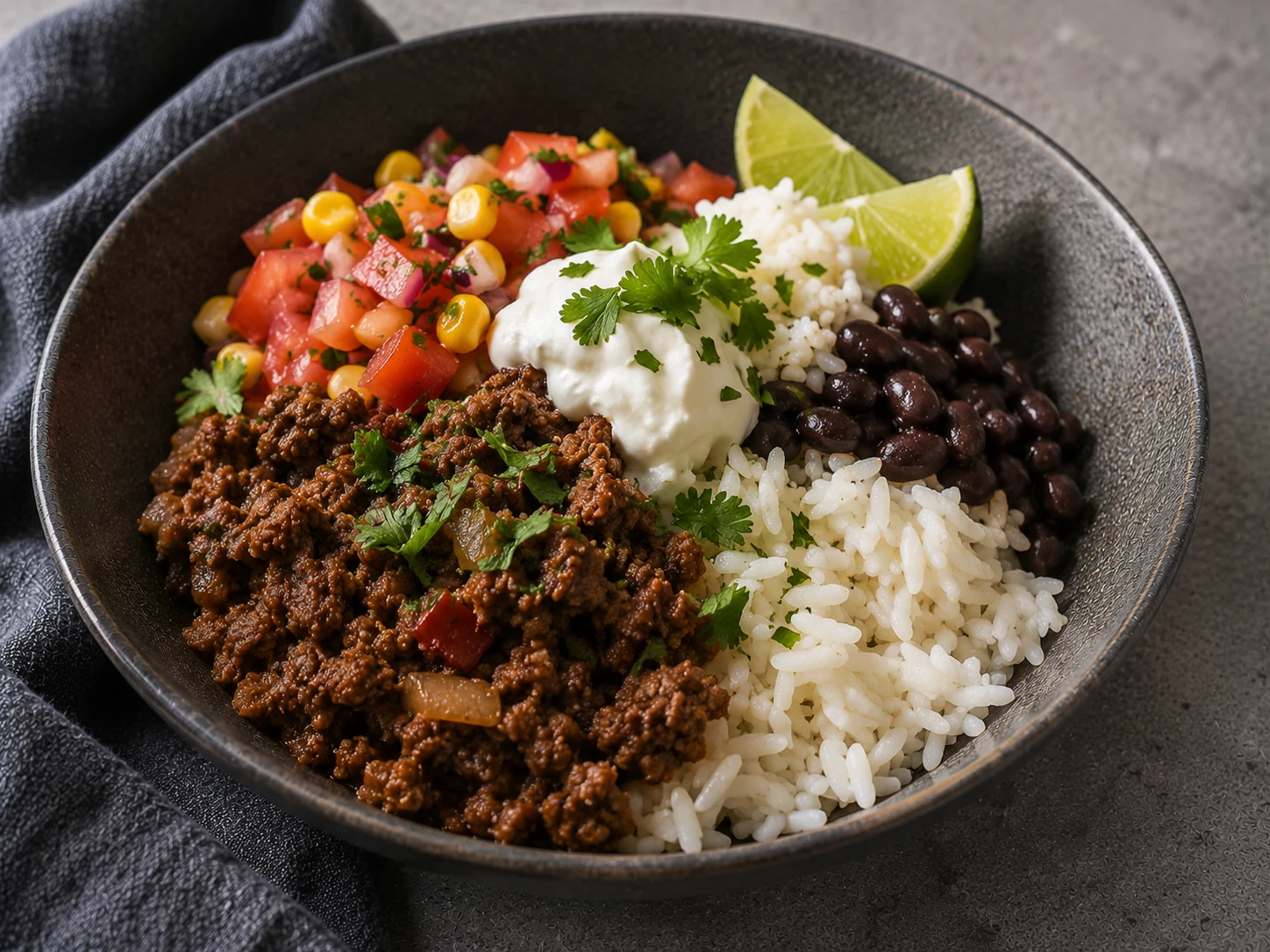
The Fuel Rx week is week 1 of December 2026 from our program: a yoghurt bowl most mornings, five lunches from last night's dinner, seven dinners (honey mustard chicken tray, Mexican beef bowl, Cajun chicken, beef and broccoli, Portuguese chicken, steak and sweet potato, beef ragu) from two proteins and one shop. Winging it, the same week is 21 decisions, made tired, with three or more trips to the shops.
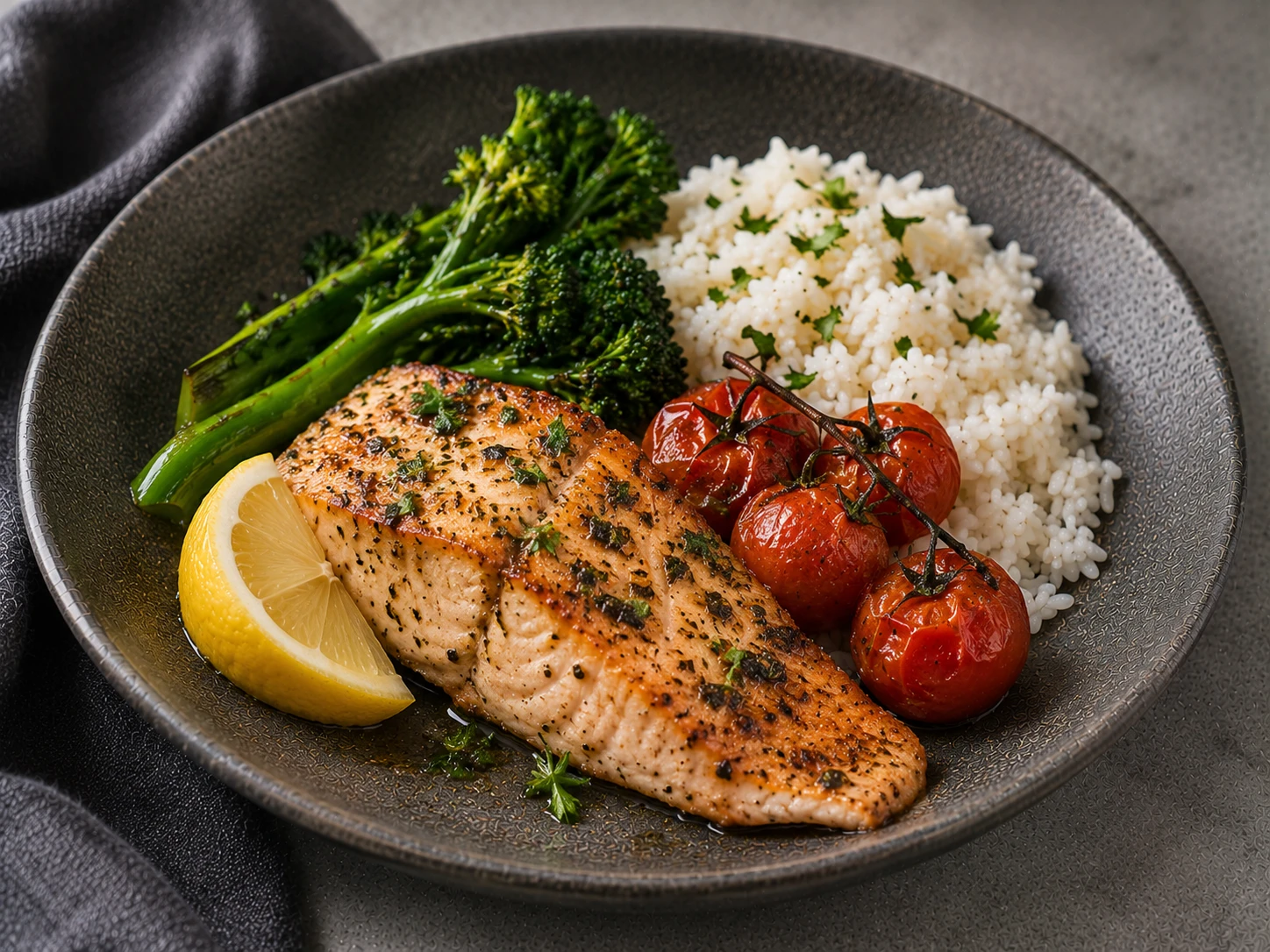
The Fuel Rx week is real: week 1 of December, straight from the plan in your app, with the program's own recipe photos. The winging-it week is illustrative, the pattern we hear at check-ins.
Winging it isn't a character flaw. It's 21 decisions a week, most of them made at the worst possible time. When the decision lands at 5:30, the answer is whatever's fastest. Not because you don't know what to eat. Because nothing was decided earlier.
That's the gap Fuel Rx closes. The coaches write the month of food the way we write the month of training. It lands in your app already sized to your numbers. You can still change anything. You just never start from a blank page again.
We program the workouts you'd skip. Now the food.
Think about the session you'd never pick for yourself. For a lot of you it's the long aerobic piece: the row, the run, the engine work. If you wrote your own program it wouldn't be there, because you're not good at it and it isn't fun. We program it anyway, and you do it, because it's the session that gives you the most back.
Food works the same way. Left alone, most of us eat the same few easy things, and the stuff that does the most for us (veg, fish, beans, real food cooked at home) is the first to drop off. So we program it in. Fuel Rx is built on more veg, more whole food and protein at every meal, and here's what that buys you.
Adherence is the number that matters
When researchers put 160 adults on four famous diets for a year (Atkins, Zone, Weight Watchers and Ornish), the diet didn't decide the result. How well people stuck to it did.4 That's the whole game: not the perfect diet, the one you'll follow.
And a plan written for you is the best tool we know for following it. In a 1996 trial, 163 women all got the same weekly weight-loss coaching. The ones who also got a structured meal plan and a shopping list lost around 11 to 12 kg in six months, against 8 kg with coaching alone. Getting the food itself for free added nothing on top of the plan.2 Across more than 40,000 French adults, people who planned their meals ate a more varied, better diet and were less likely to be living with obesity.3 People who cook dinner at home most nights eat 98 g more veg a day than those who rarely do.5
The shop, the leftovers, the same breakfast, the number of new dishes: each one is set so you can stick to the week. Adherence is the score we program for.
Too boring fails. Too much fails.
First, what we mean by adherence: sticking to it. Of the meals in your plan this month, how many did you actually eat? That's the number every choice in Fuel Rx is built to push up.
Here's the trade every meal plan makes. Strip it right back to the same meal every day and it's dead easy to follow, for about a fortnight. Then people quit, because there's nothing to look forward to. Go the other way, a different meal every day, new ingredients, an hour at the stove, and it's exciting and impossible to keep up. People even eat more when there's more variety on the table.9 Sticking to it is highest in the middle, and our job is to keep every month there.
The month
Sticking to it is low at both ends: the same meal every day is easy but people quit from boredom; a different meal every day is exciting but too much work. We keep every month inside five limits: 10 to 14 different dishes a week, two proteins to shop for, four or five lunches from last night's dinner, under 20 minutes a day of hands-on prep, and a handful of new dishes a month. December sits inside all five.
November and December are measured from the plans in your app, recipe by recipe: hands-on minutes are each recipe's prep time (the oven and the slow cooker don't count, you're not standing there). The holidays and January are how we'd program them. The curve is the shape of the trade, not a lab measurement.
That's the equation behind every month. We don't guess at the sweet spot; we build inside five limits, and the biggest one is overlap. Two proteins a week, so it's one shop. Dinner cooks double, so lunch is already done. The same breakfast most mornings. Dishes that come back month to month, so you're not learning something new every night. A week can have 12 different dishes on it and still feel simple, because the pieces repeat.
And time is the one we guard hardest, because we're programming for parents. Lack of time is the reason people give most for not cooking, and the people who spend the least time preparing food eat the fewest vegetables and the most takeaway.16 So December asks for about 17 minutes of hands-on work a day across all three meals. A weeknight dinner is around 9 minutes of chopping, then the oven or the pan does the rest while you sort the kids.
Then we move the month around inside those limits, the same way we program training. After the holidays, when everyone's had three weeks of everything, January reins it in: the anchors, the quickest dinners, almost nothing new. When the gym is settled and sticking to it, we add a few new dishes. Then we pull it back before it tips over.
The fanciest meal plan in the world loses to the one you'll cook on a Wednesday.Coach's note
Why three meals, not the old five
If you've been around gyms a while, you were told to eat five or six small meals a day to "keep the metabolism firing". It doesn't hold up. Both ways can land on exactly the same calories and protein by the end of the day. The difference is how you feel getting there. When people eat the same food split into more meals, they don't lose more weight or burn more fat.1011 In one study, six meals instead of three left people hungrier and wanting to eat more.11 A review of the trials found no real difference in fat loss once the day's total was the same.13 And when researchers put dieters on three or six meals a day with more protein, the protein made them fuller, and the extra meals didn't help at all; three bigger, balanced meals left them fuller than six small ones.15
The old way: five small meals
Snack-sized, every 2 to 3 hours
- Five times a day to prep, pack and think about food.
- Small plates rarely fill you, so you graze.
Fuel Rx: three real meals
Breakfast, lunch, dinner

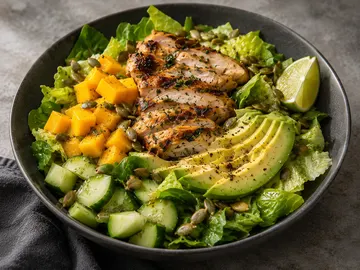
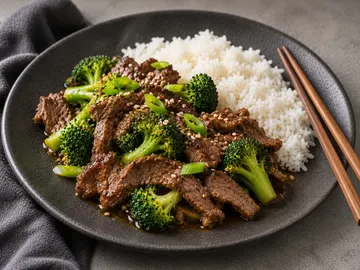
- Same daily total, bigger balanced plates: protein, veg and carbs together, so you stay full till the next one.
- Lunch is last night's dinner, so it's really 14 things to plan.
Your targets don't change. The app sizes the three meals to the calories and protein your scan sets. If your numbers are big (or you train twice a day) a shake or a dessert from the program fills the gap.
Three meals is easier to plan, easier to shop for and easier to stick to, which is the whole point. Each one is big enough to carry a real hit of protein, the kind that switches muscle building on, rather than a few bites across a day of snacks. And three real meals fit family life. Nobody's kids are eating at 10 am, 1 pm and 3:30.
Nutrition was always the base. Now it's programmed.
In 2002 CrossFit drew its pyramid of how an athlete is built. Sport at the top, then lifting, gymnastics and conditioning, and underneath all of it, holding the rest up: nutrition.1 We've programmed the top four levels every day since the gym opened. The base was the one you had to sort out yourself.
How an athlete is built
CrossFit's pyramid (Glassman, 2002)
Inside the base: Fuel Rx
What matters most is at the bottom
CrossFit's pyramid, bottom to top: nutrition, conditioning, gymnastics, lifting, sport. Inside the base, bottom to top: a plan you'll follow, the amount, the quality, timing, and supplements last.
Get the bottom two right and the rest follows. Supplements sit at the top because they matter least, which is why we talk about them last.
Most nutrition advice starts at the top: the supplement, the timing trick, the superfood. We start at the bottom. A week you'll follow, sized to your numbers, built on protein and plants. Get those right and you can skip almost everything people argue about online.
What each meal trains
A heavy deadlift day trains strength. A long row trains your engine. Nobody does one workout forever, and a good week of training covers the lot. Food is programmed the same way. Every recipe hits some things hard and others barely at all, and the week is built so that together they cover your whole web. Tap a meal, then tap The week.
The meal
Six things every week has to cover: complete protein, fibre, colour (vitamins and minerals), omega-3, iron and zinc, and fuel. Beef and broccoli is big on protein and iron; honey soy salmon carries the omega-3; protein oats are the fuel and fibre; the Mexican beef bowl brings beans for fibre. No one meal covers it all. The week does.
Scored 0 to 5 by the coaches from each recipe's ingredients, not a lab test. It's how we check a month before it goes in your app: every spoke covered across the week, the way a training week covers every skill.
Take protein. Not all protein is equal. Meat, fish, eggs and dairy are complete: they carry all nine essential amino acids, the ones your body can't make, including leucine, the one that switches on muscle repair. That's why every Fuel Rx meal has a palm or two of it, breakfast included. Red meat brings the iron and zinc your body absorbs best, which matters for anyone training hard, and for a lot of women. Salmon brings omega-3, which is why fish turns up in the program at least once a week. Beans, veg and oats carry the fibre. And the more colours on the plate across a week, the wider the spread of vitamins and minerals.
You don't need to track any of that. That's our job when we write the month. You just eat the week.
Three real meals. Protein at every one. Half the plate plants. Carbs for the work you do. A week written for you, shopped once, cooked once and eaten twice. Enough new to look forward to, never so much you can't stick to it.
Your week, in the app
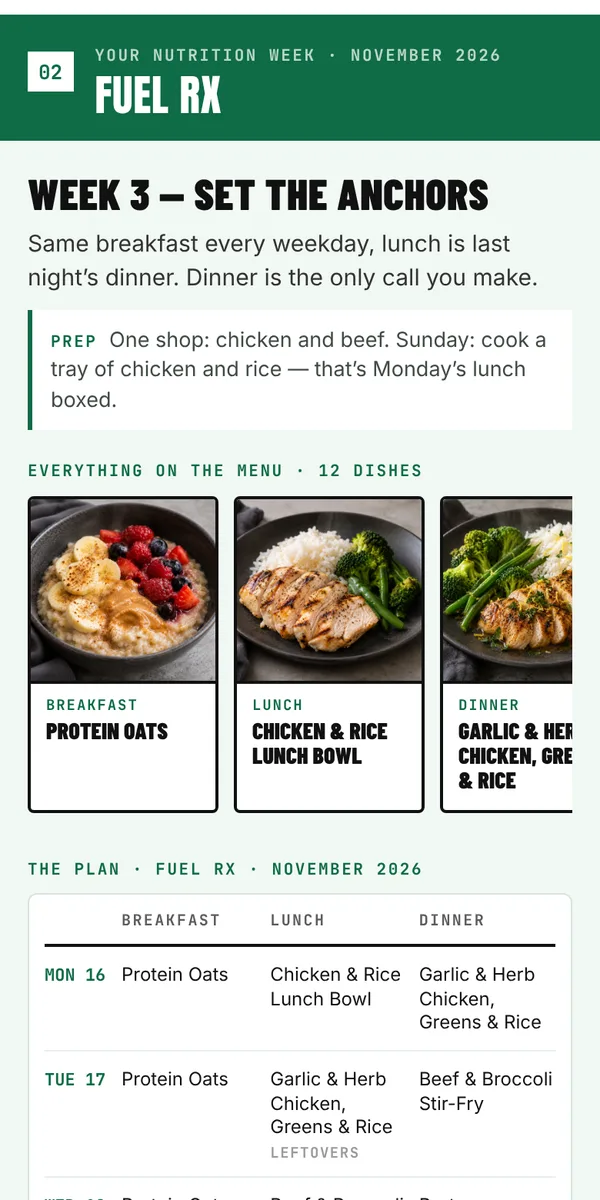
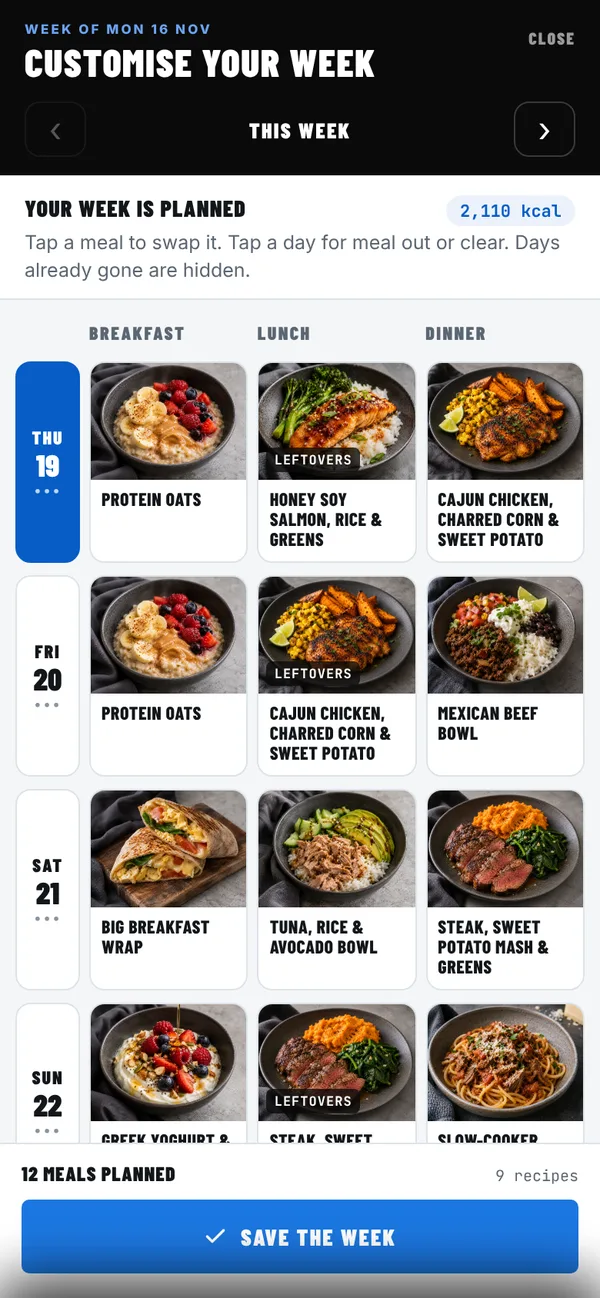
Ten minutes on a Sunday, then the week runs itself. These are the real screens, from a test account in our app.
 ABC
- Fuel Rx sits under your training in the Weekly Rx, with the week's one job and the prep.
- Everything on the menu, once, with photos.
- The plan for the week, day by day. Tap to open it.
 ABC
- Tap any meal to swap it. The kids won't eat it? Pick another. It's written to your numbers.
- Tap a day to mark a meal out or clear it.
- Save the week. Print it for the fridge if you like.
 ABC
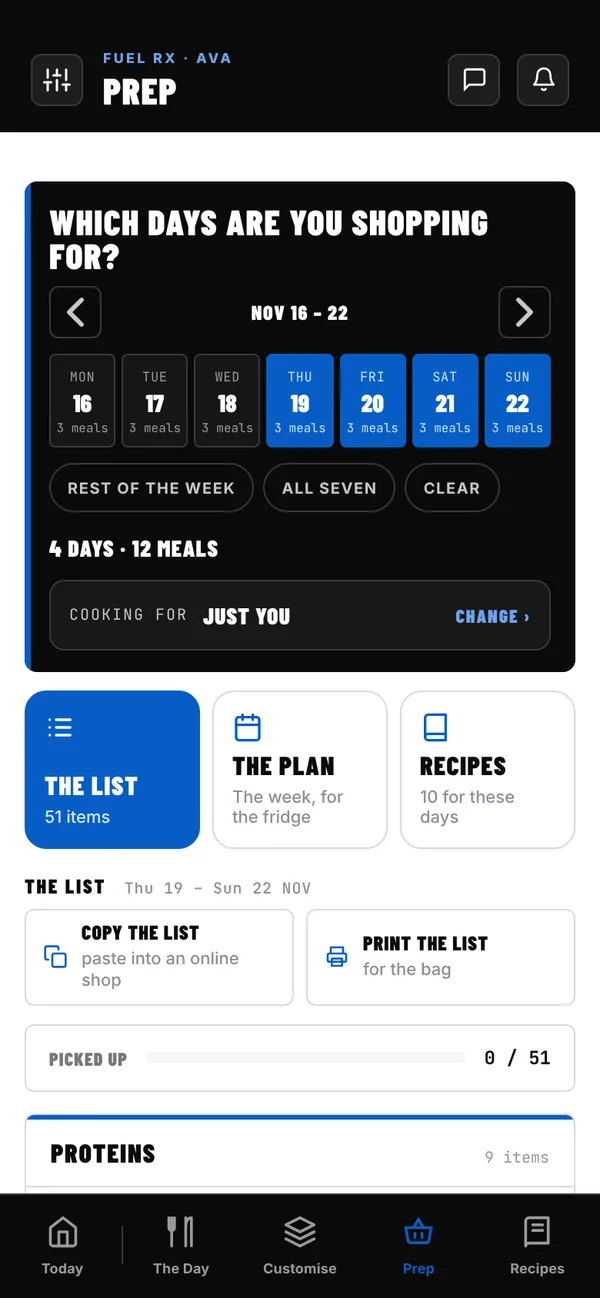
- Pick your shopping days. One shop or two, your call.
- Who you're cooking for. Tap Change (next screen).
- The list builds itself, by aisle. Copy it or print it.
 ABC
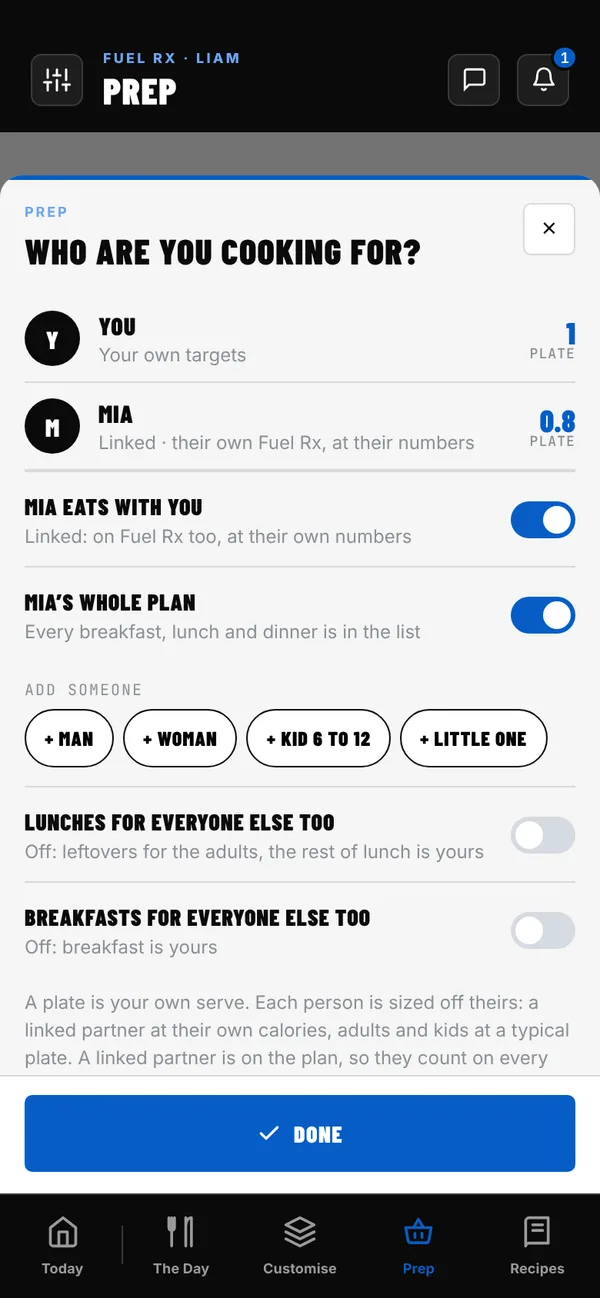
- A linked partner is on Fuel Rx too, so the list covers their whole plan at their numbers. Eating with you at dinner only? Switch it off.
- Add the kids or a guest. They're in every dinner, sized to a typical plate.
- Feeding them lunch or breakfast too? Flick these on and the list grows.
 ABC
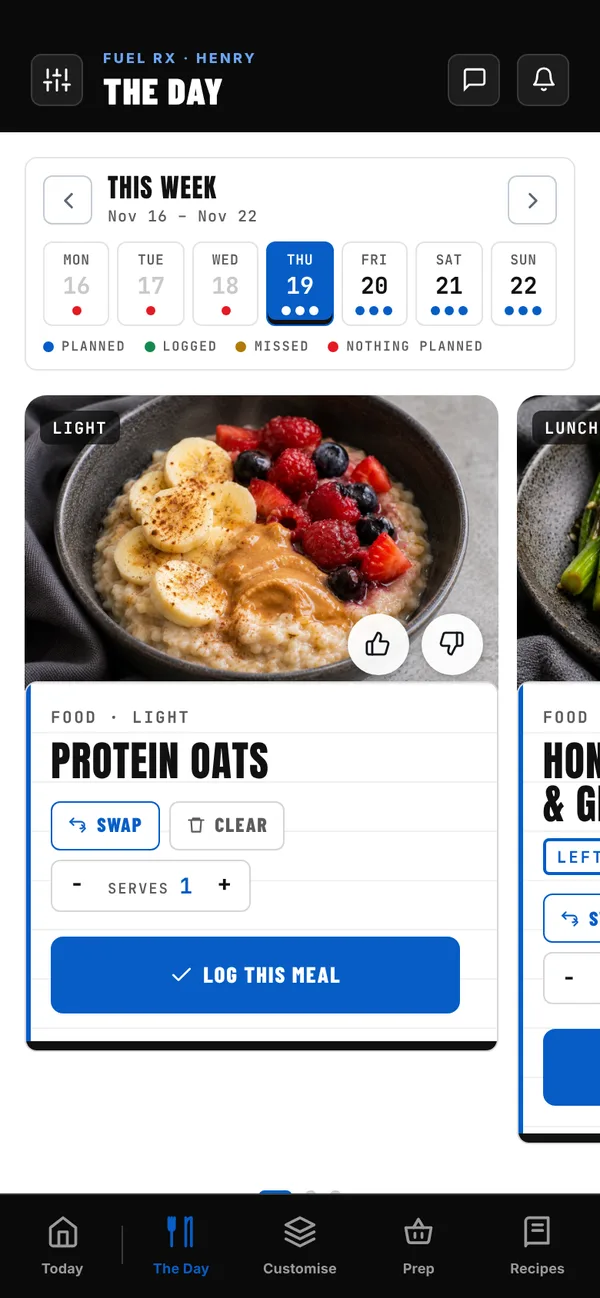
- Would you cook it again? Thumbs up or down. It shapes next month.
- Swap it on the day if plans change.
- Cook it, eat it, log it. The recipe's one tap away.
Real screens from a test account on our app. Fuel Rx is part of every membership. Welcome to Fuel Rx is the three-minute tour, and each month has its own post.
The monthly post is the bit you'll come to know. Before each month starts, the coaches put out its plan: what we're working on, where it sits on the sweet spot, every week, every recipe and how to handle the big days. December's is out now. It's the whiteboard, just for food: you walk in, it's already written, and everyone in the room is doing it with you.
"I don't want to be told what to eat"
Fair. Nobody does. So here's what Fuel Rx isn't.
It isn't a diet. There's no banned list and no "clean" week followed by a blowout. The weekends, the barbecues and Christmas are in the plan, on purpose.
It isn't one portion for everyone. The recipes are shared; the amounts are yours. That's why this post never prints grams.
It isn't rigid. The program is a starting point, the same way a scaled workout is. Swap a dinner the kids won't touch. Move Thursday's to Friday. The one thing we ask is that you don't go back to a blank page. Kids who eat with their family three or more times a week eat better and are less likely to be overweight,14 so put the same plate in front of them. The chilli goes on the side.
And if the training's going well but the food isn't, tell your coach. That's what check-ins are for.
The questions we get asked most
Tap a question to open it.
Do I have to eat exactly what's on the plan?
No. It's a starting point, like a scaled workout. Swap any meal in Customise and the new one is written to your numbers. What we're after is sticking to it most of the time, not a perfect week.
My kids won't eat it. Now what?
Every recipe is written to be family food: mild, with the chilli and the strong stuff on the side. If there's one they won't touch, swap it. In Prep, add the kids to who you're cooking for and the shopping list grows to feed them.
What about my partner?
If they're a member and linked to you, they're on Fuel Rx too, at their own numbers, and the list covers their whole plan. If they'll only eat with you at dinner, switch them to dinners only. Not a member? Add them in Prep and they're in every dinner.
Do I have to log my meals?
Yes. It's one tap on The Day, and it's how your coach knows if the plan is working. If the scan isn't moving and nothing's logged, we're guessing. If it's logged, we can fix it.
Do I have to weigh my food?
In the early days, yes. It's how you learn what a portion looks like. After a few months most people can eyeball it and check now and then. Weigh it now. Eyeball it for life. explains why.
How are my portions worked out?
From your body scan and your targets. Everyone gets the same recipe and the app sizes it to you, which is why this post never prints grams. Your plate and your partner's can be different sizes.
What about nights out, birthdays and Christmas?
Put them in your week as a meal out, then enjoy them. No making up for it the next day. You're back on the plan at the next meal.
I don't eat certain foods. Does it still work?
Swap anything you don't eat in Customise and pick from the Recipe Book. For an allergy or a medical diet, talk to your coach and your GP first.
Three meals won't get me to my numbers. What then?
If your targets are big or you train twice a day, add a protein shake after training or one of the program's desserts. The app shows you where you're short.
Do I need supplements?
No. Food comes first. Creatine and protein powder are the two we'd ever suggest, and only once the food is right. Our partner is Ascend Performance, and each month's post has the details.
Does Fuel Rx cost extra?
No. The program is part of every membership. If you want a coach working on your food with you month to month, Fuel Rx coaching is there on top. Ask at the desk.
I fell off the plan for a week. Do I start again on Monday?
No. Open The Day and start at the next meal. Missing a week doesn't undo anything; waiting till Monday is what costs you.
The research
- Glassman G. What is fitness? The CrossFit Journal 2002 (October);1:1–11.
- Wing RR, Jeffery RW, Burton LR, Thorson C, Nissinoff KS, Baxter JE. Food provision vs structured meal plans in the behavioral treatment of obesity. International Journal of Obesity and Related Metabolic Disorders 1996;20(1):56–62.
- Ducrot P, Méjean C, Aroumougame V, et al. Meal planning is associated with food variety, diet quality and body weight status in a large sample of French adults. International Journal of Behavioral Nutrition and Physical Activity 2017;14:12.
- Dansinger ML, Gleason JA, Griffith JL, Selker HP, Schaefer EJ. Comparison of the Atkins, Ornish, Weight Watchers, and Zone diets for weight loss and heart disease risk reduction: a randomized trial. JAMA 2005;293(1):43–53.
- Mills S, Brown H, Wrieden W, White M, Adams J. Frequency of eating home cooked meals and potential benefits for diet and health: cross-sectional analysis of a population-based cohort study. International Journal of Behavioral Nutrition and Physical Activity 2017;14:109.
- Aune D, Giovannucci E, Boffetta P, et al. Fruit and vegetable intake and the risk of cardiovascular disease, total cancer and all-cause mortality: a systematic review and dose-response meta-analysis of prospective studies. International Journal of Epidemiology 2017;46(3):1029–1056.
- Reynolds A, Mann J, Cummings J, Winter N, Mete E, Te Morenga L. Carbohydrate quality and human health: a series of systematic reviews and meta-analyses. The Lancet 2019;393(10170):434–445.
- Hall KD, Ayuketah A, Brychta R, et al. Ultra-processed diets cause excess calorie intake and weight gain: an inpatient randomized controlled trial of ad libitum food intake. Cell Metabolism 2019;30(1):67–77.
- Raynor HA, Epstein LH. Dietary variety, energy regulation, and obesity. Psychological Bulletin 2001;127(3):325–341.
- Cameron JD, Cyr MJ, Doucet É. Increased meal frequency does not promote greater weight loss in subjects who were prescribed an 8-week equi-energetic energy-restricted diet. British Journal of Nutrition 2010;103(8):1098–1101.
- Ohkawara K, Cornier MA, Kohrt WM, Melanson EL. Effects of increased meal frequency on fat oxidation and perceived hunger. Obesity 2013;21(2):336–343.
- Morton RW, Murphy KT, McKellar SR, et al. A systematic review, meta-analysis and meta-regression of the effect of protein supplementation on resistance training-induced gains in muscle mass and strength in healthy adults. British Journal of Sports Medicine 2018;52(6):376–384.
- Schoenfeld BJ, Aragon AA, Krieger JW. Effects of meal frequency on weight loss and body composition: a meta-analysis. Nutrition Reviews 2015;73(2):69–82.
- Hammons AJ, Fiese BH. Is frequency of shared family meals related to the nutritional health of children and adolescents? Pediatrics 2011;127(6):e1565–e1574.
- Leidy HJ, Tang M, Armstrong CL, Martin CB, Campbell WW. The effects of consuming frequent, higher protein meals on appetite and satiety during weight loss in overweight/obese men. Obesity 2011;19(4):818–824.
- Monsivais P, Aggarwal A, Drewnowski A. Time spent on home food preparation and indicators of healthy eating. American Journal of Preventive Medicine 2014;47(6):796–802.