

Four hours a week. Spend them on one system.
You're a mum or dad with about four hours a week to train. Everyone wants a piece of them: be strong, be fit, do your mobility, don't get hurt. So you get pulled in every direction, and you end up nowhere.
Pulled every direction
- The 5K app
- The Instagram lifting coach
- The YouTube mobility routine
- The physio's sheet on the fridge
One coached system
- Written by your coaches
- Every Sunday, off your profile
- A coach runs every class
- Rescanned to prove it
Illustrative: the advice parents bring to their intro, added up. The webs are drawn by the coaches on the app's six elements.
You don't need more hours. You need one system that delivers all of it. Here's what "all of it" means.
Fitness is six things. You need all six.
CrossFit was built on being good at everything, not one thing.1 We split that into six elements we can test, the same web you'll see on every workout in the app.
Four kinds of day train them:
Strength
- It is
- The heavy squat, deadlift and press.
- It does
- Builds the muscle. Props up the other five.
- You feel it
- Carrying the sleeping four-year-old from the car to bed, up the stairs, without waking her.
Ten weeks of strength training can add about 1.4 kg of lean weight.2
Power
- It is
- Force, fast. Cleans, jumps, throws.
- It does
- A body that reacts quickly.
- You feel it
- Throwing the kids in the pool, again and again. Catching yourself when you slip on the Lego.
Speed & anaerobic
- It is
- All-out efforts of a few minutes or less.
- It does
- A higher top gear, and a faster bounce-back.
- You feel it
- Catching the scooter before it reaches the driveway. The sprint to the school gate after the bell.
Hard intervals raised fitness nearly twice as much as steady cardio.3
Aerobic engine
- It is
- Heart and lungs over the long haul.
- It does
- Keeps you going, and helps you recover.
- You feel it
- The whole of backyard cricket, not just the first over. A day on your feet at the Ekka.
In 122,007 adults, the fitter the heart and lungs, the better the long-term health, with no upper limit found.4
Muscular endurance
- It is
- Reps without stopping: push-ups, lunges, wall balls.
- It does
- Muscles that keep working when they're tired.
- You feel it
- Pushing the pram up the hill to the park, then pushing the swing for twenty minutes.
Mobility & control
- It is
- Balance, stability, mobility and coordination.
- It does
- Good positions, so the other five don't hurt you.
- You feel it
- Up off the floor after Lego without a hand. The baby capsule into the car without tweaking your back.
Balance and coordination work two or three days a week is in the guidelines, with stretching on two or more.5
The app's six elements, in the app's order. The blue shape is a balanced week, drawn by the coaches.
Most people walk in with big holes
This is what it looks like in the real world. The three we see most at intros, each drawn against a balanced week (dashed):
Illustrative shapes, drawn by the coaches on the app's six elements. Red is the coach's pen: the gap.
"I want muscle, I want to be fit, and I don't want to get hurt." You can have all of it, by balancing what you do. Not sure where your holes are? What type of athlete are you? has seven types to pick from.
All six, in about four hours a week
No single workout trains all six. The week does. Four real classes, as the app reads them:
Real classes from our whiteboard, read by our stimulus formula, the same one that draws the web in your Class notes. The week's web is the best each element got across the four.
Notice what isn't there: a separate mobility hour. Control is trained inside every class, from the warm-up to the positions your coach fixes on every lift.
Profile. Plan. Execute. Result.
Four steps. We do the planning; you turn up.
Why it matters
You can't balance what you haven't measured. A scan doesn't guess, and your tests show exactly where your holes are, so the plan builds what you're missing first.
Why it works
Strength and engine in the same week: across 43 studies, adding cardio didn't cost people muscle or strength.6 Each muscle trained twice a week grows more than once.7 It's the mix the guidelines ask for: aerobic work plus strength on two or more days.8,5 And it's broad on purpose; CrossFit was built on being good at everything, not one thing.1
Why it works
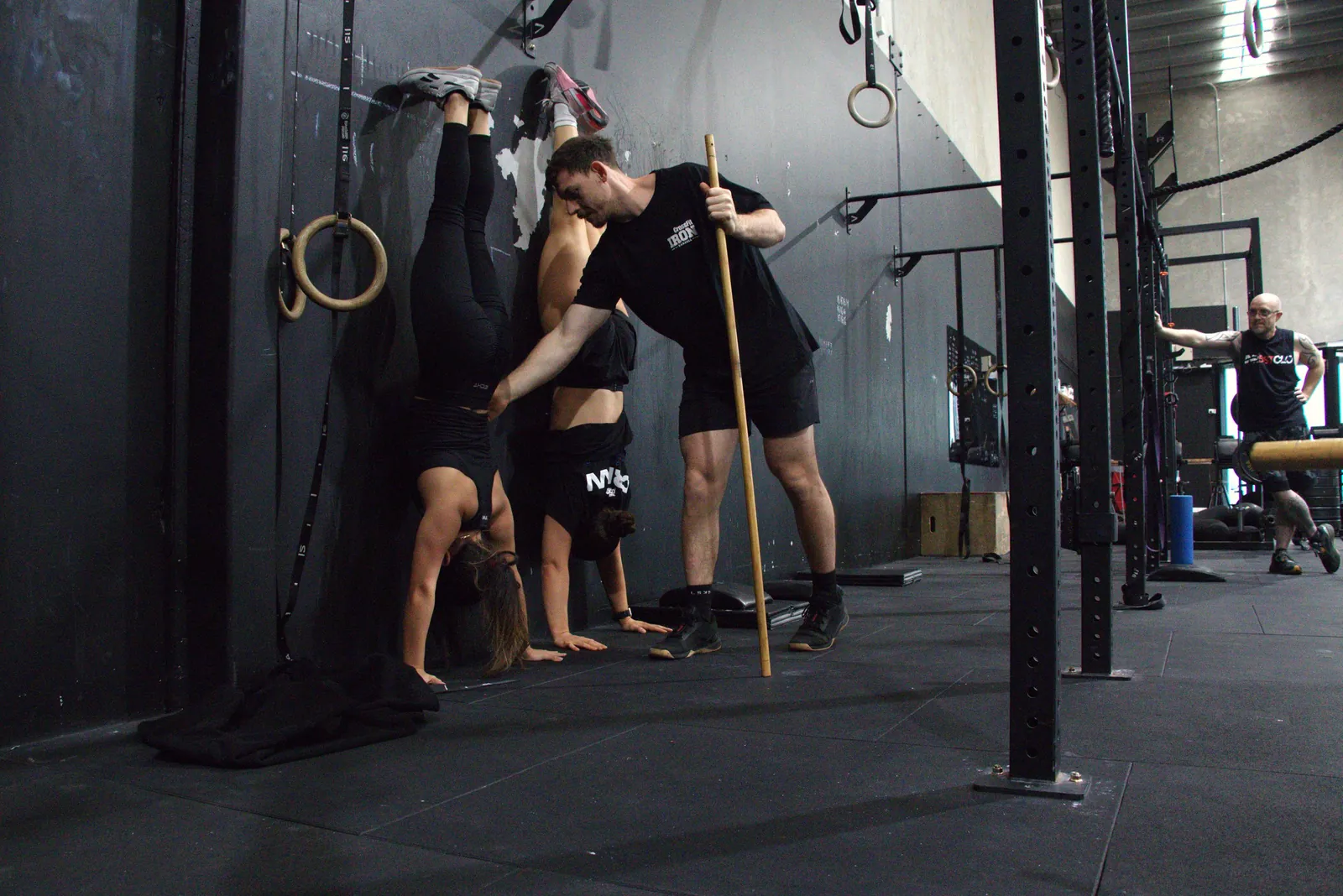
Lifters with a coach beside them lifted heavier through the program and finished stronger than the same program done alone.9 A review of 11 trials found the same for strength and balance.10 In 44 studies, people in a real group did better than people training alone with no leader.11 Hard but scaled: hard intervals raised fitness nearly twice as much as steady cardio.3
Why it works
Ten weeks of strength training can add about 1.4 kg of lean weight and take about 1.8 kg of fat off, and your resting metabolism rises about 7%.2 Measuring it is how we know it's yours: a scan doesn't guess.
Four steps: your profile is set at your intro from a scan and your first tests, your training plan comes from us every Sunday, you execute it in coached classes, and you get rescanned and retested at Day 30, then every 60 days. Each box opens to the reasons behind it.
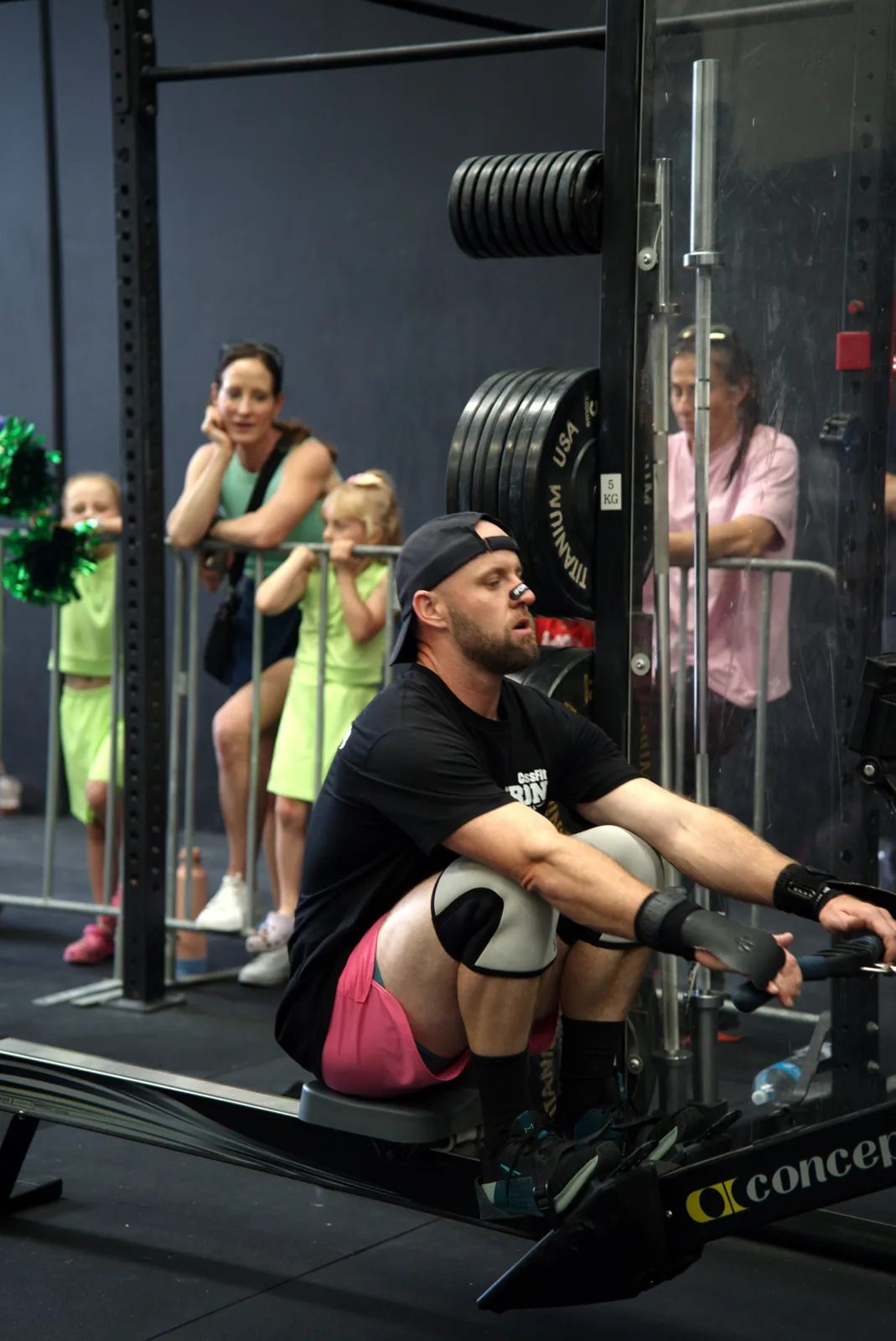
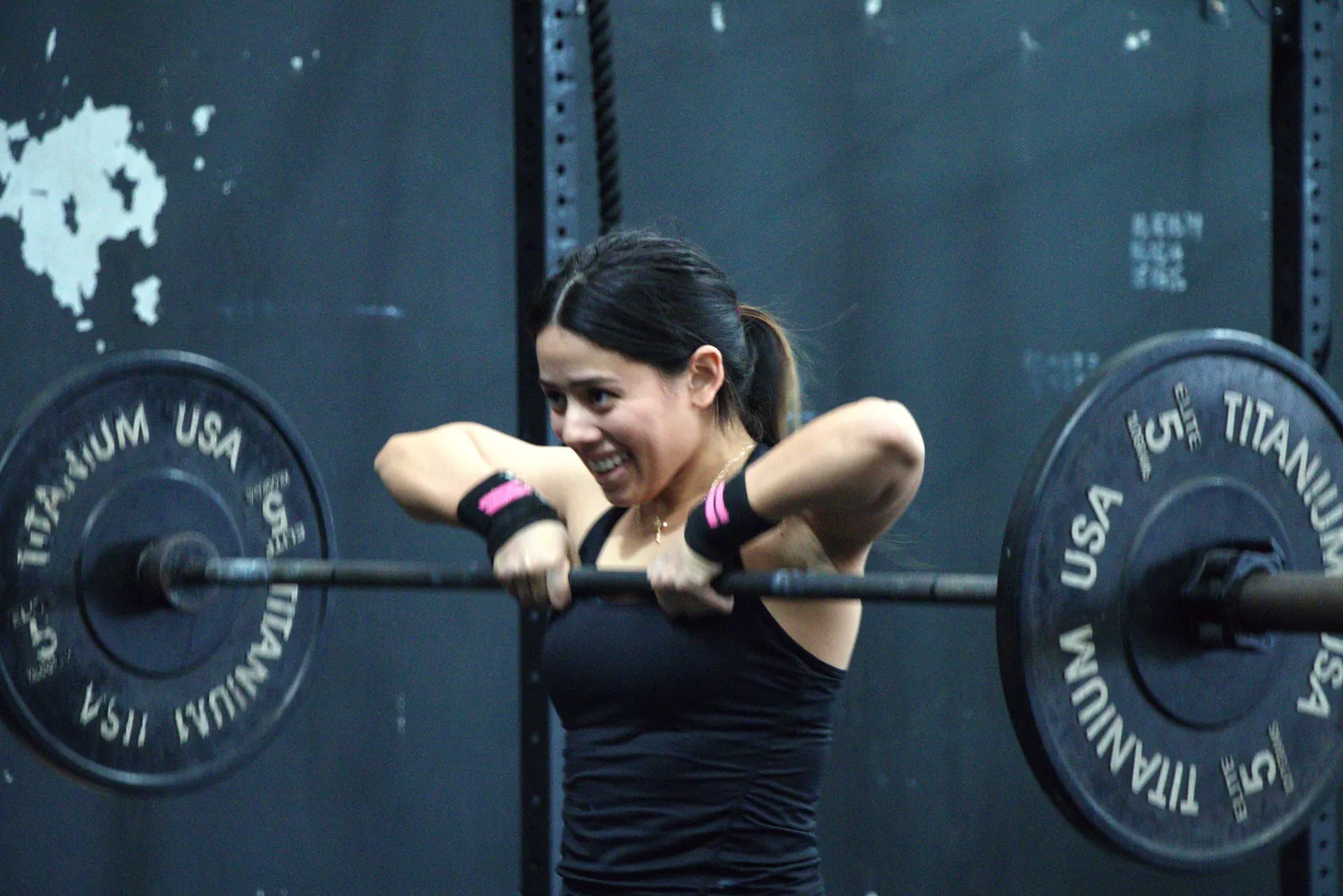
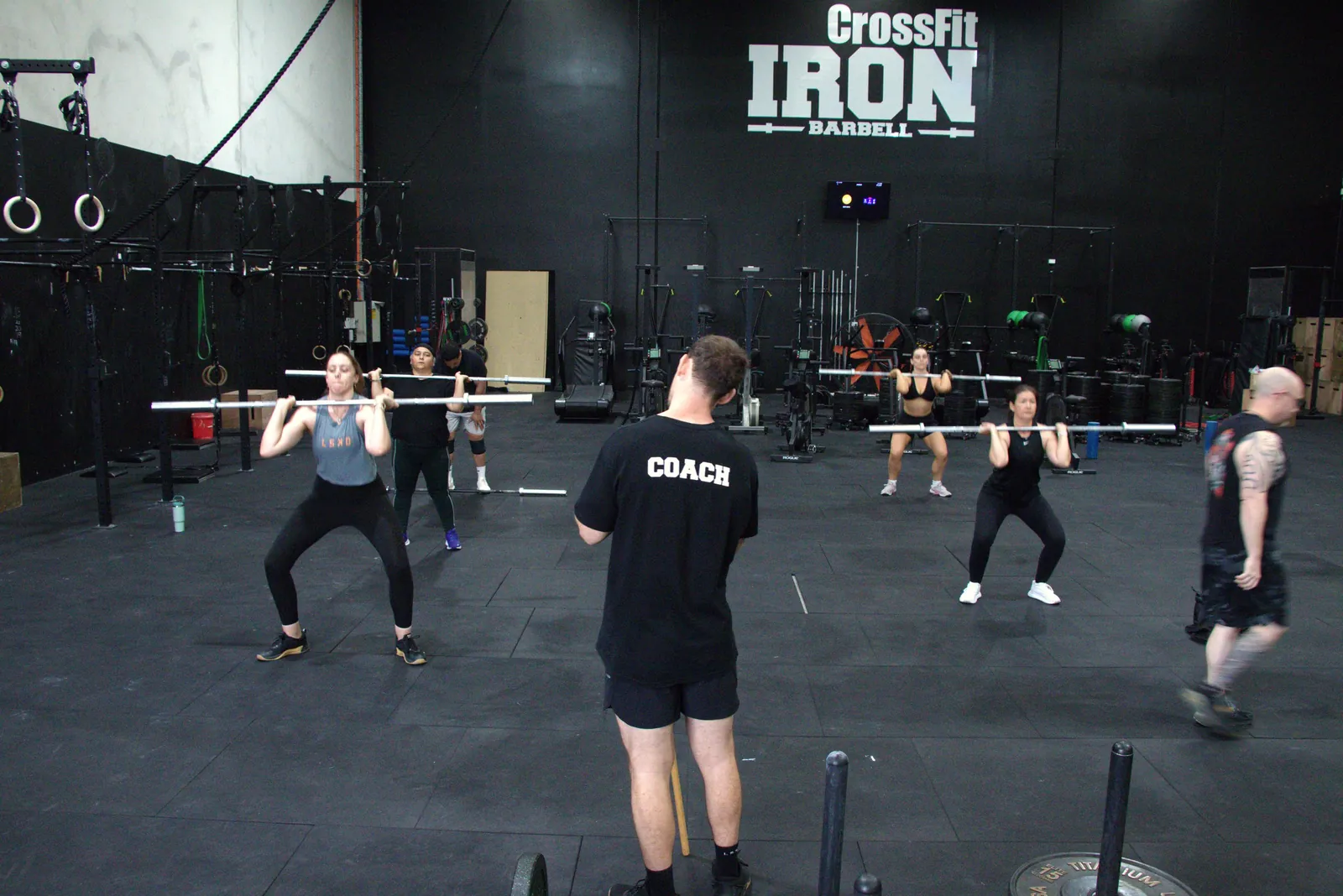
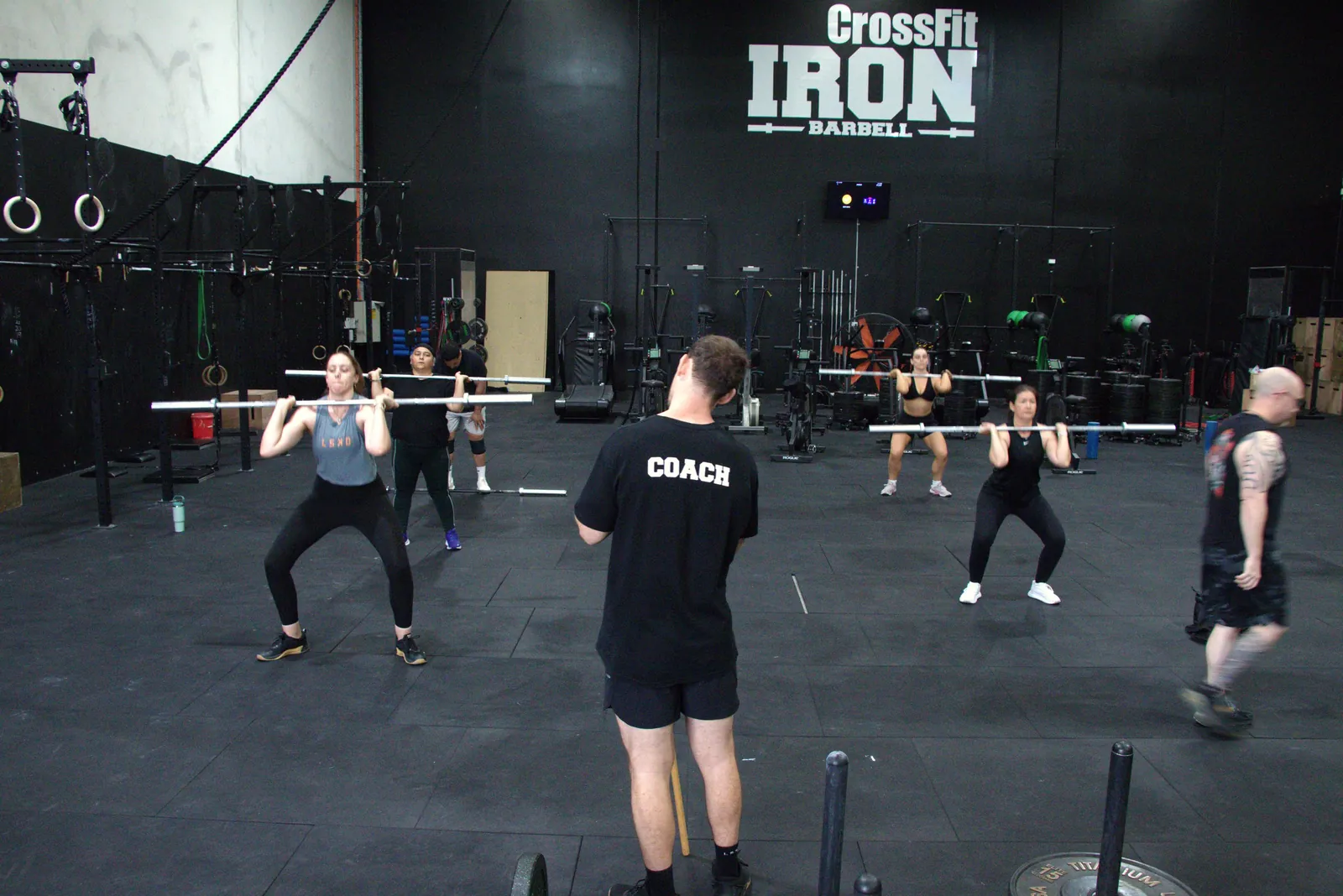
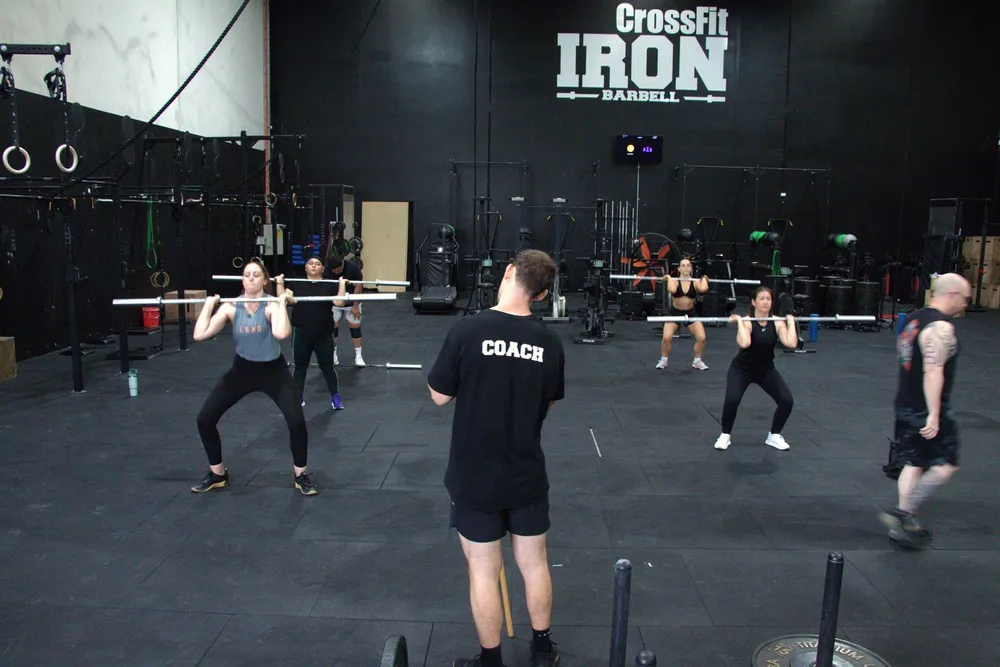
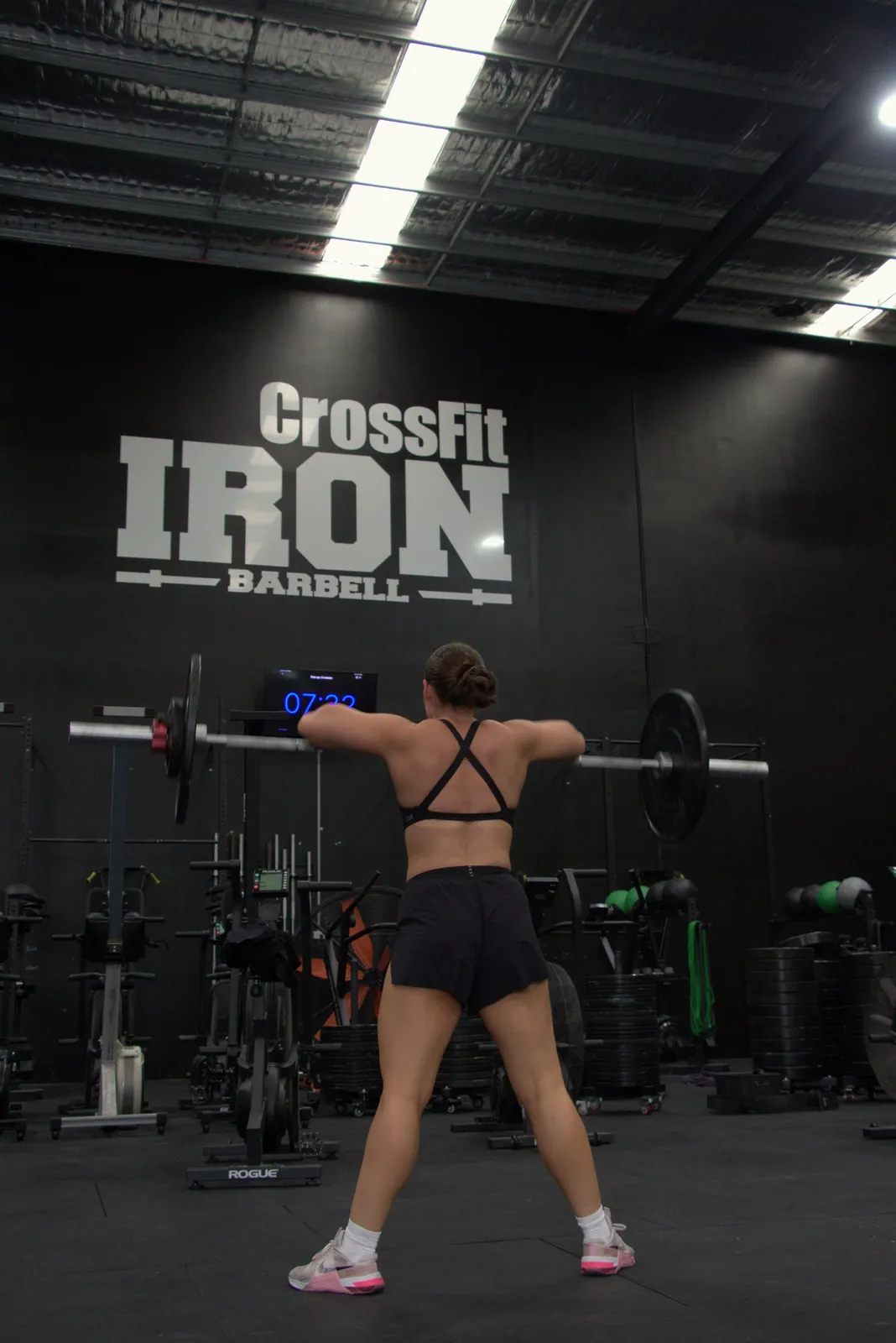
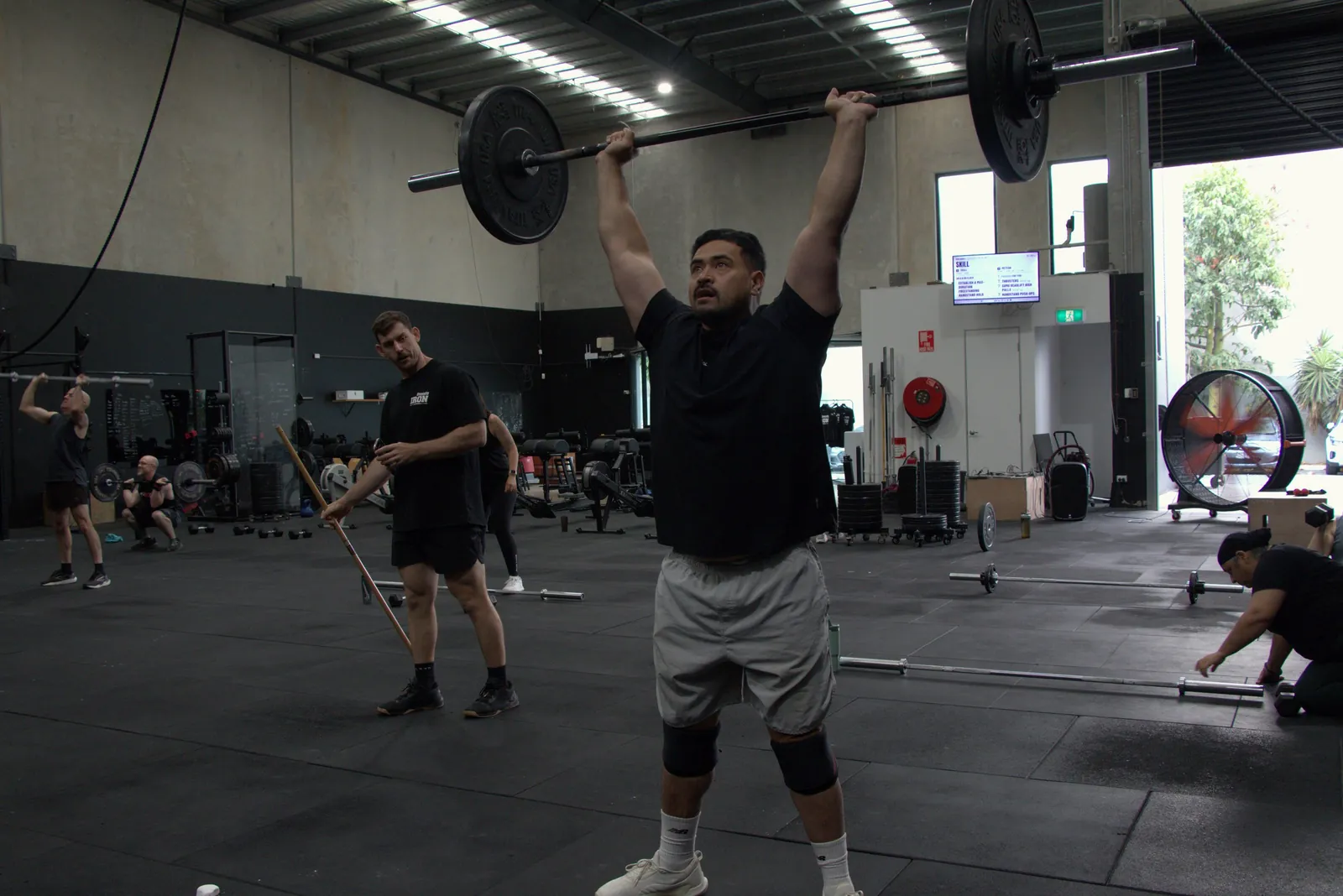
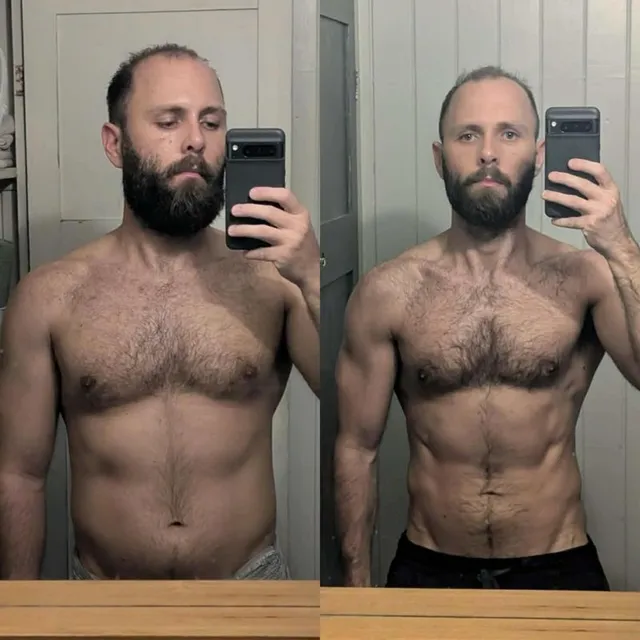
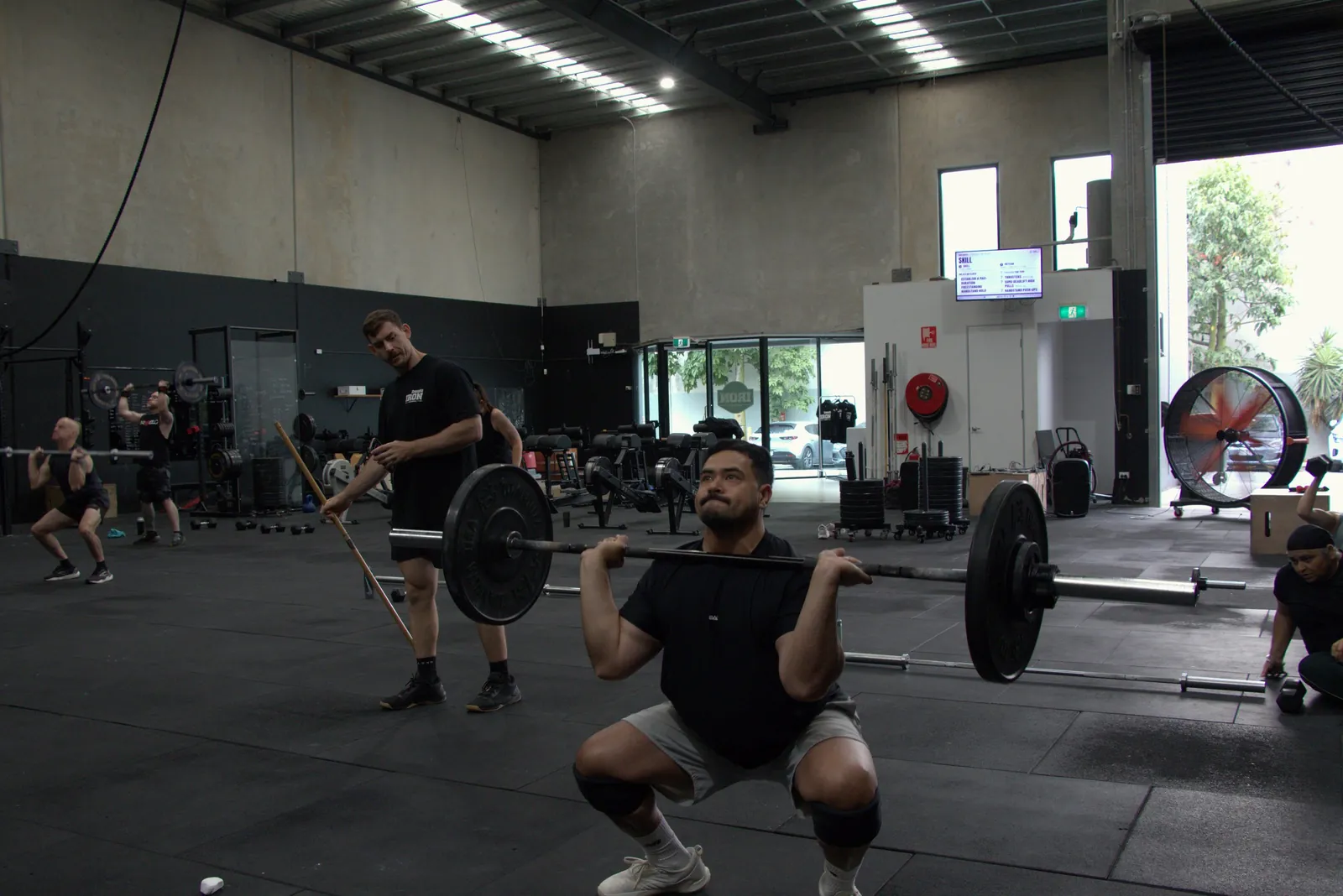
Real members, real classes (photos from our own classes). The research is in the tap-to-open boxes and the refs at the end.
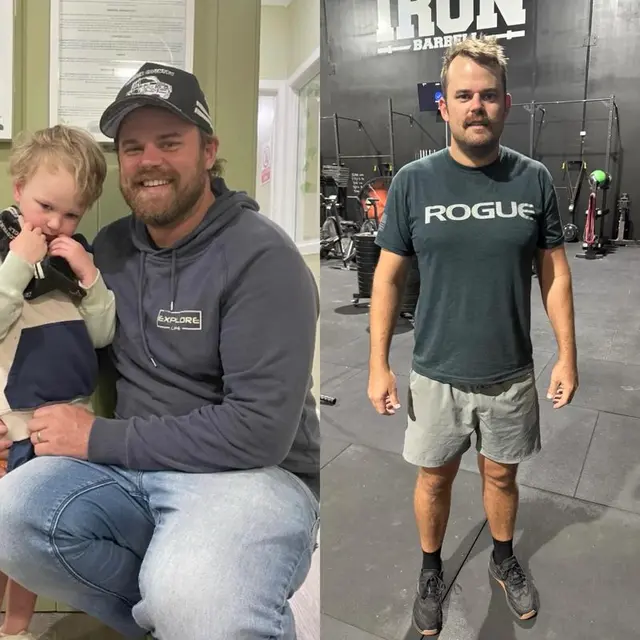
Train Rx builds it. Fuel Rx, the food half, takes the fat off. Here's what the two do together for members who started where you are.

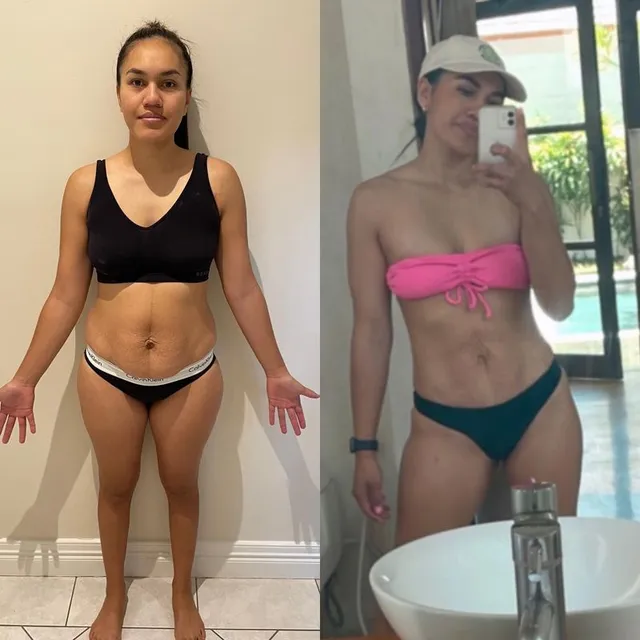
4 Kids later and I can honestly say this is the strongest I've EVER been.
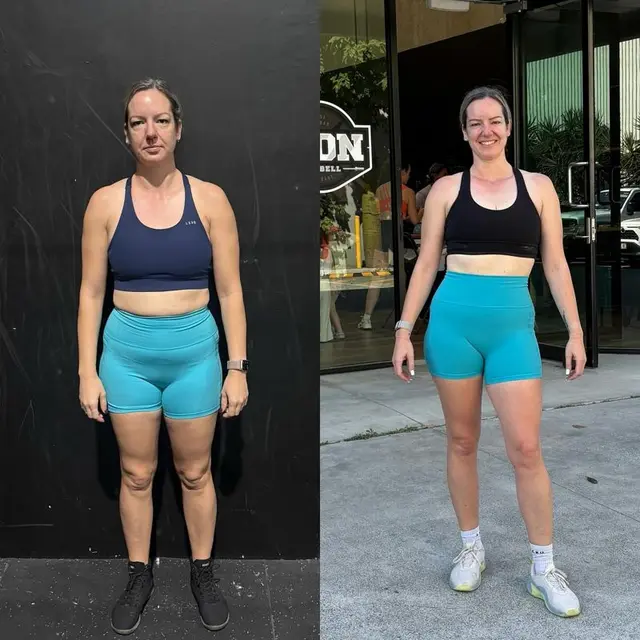
Real Iron Barbell members, shared with their permission, with the numbers as they posted them in our Wins group and on Instagram. Results vary with the person and the effort.
Your week is written before you're out of bed on Monday
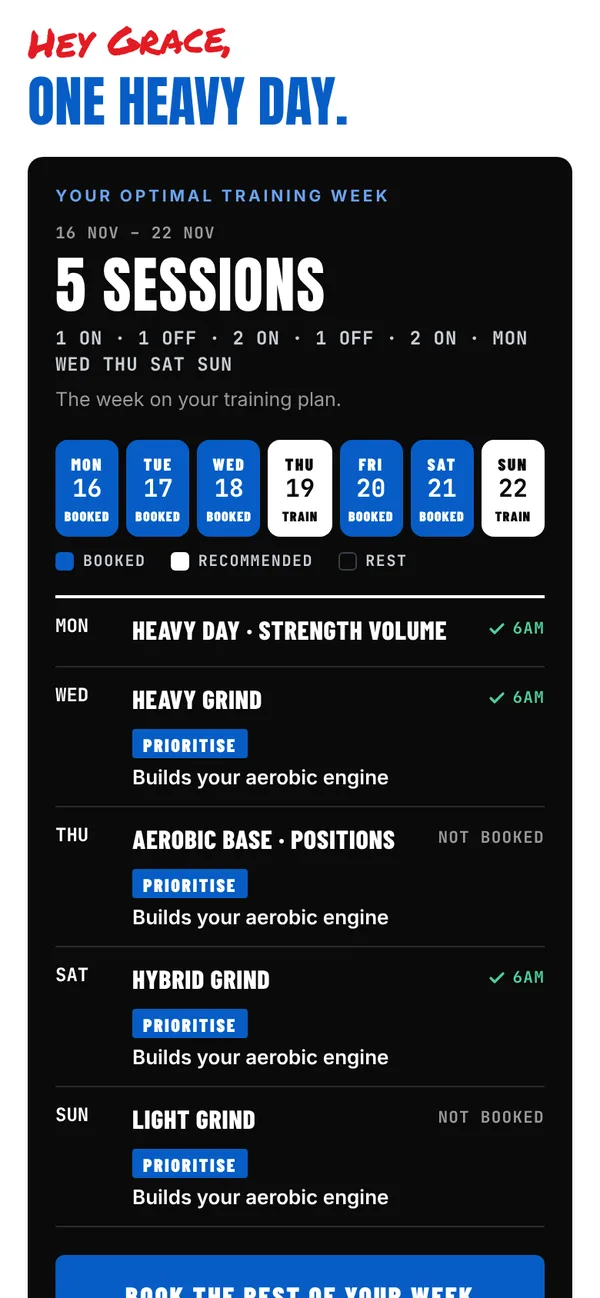
Every Sunday the coaches send the Brief. Its first section is your optimal training week, balanced across all six and tilted toward your holes with priority days. Book the lot in one go, and Wednesday's 5:30AM is already decided.
 ABC
- Your optimal week: your number of sessions and the best shape for them.
- Blue is booked, white is recommended. One look tells you what's missing.
- Prioritise: the days that build what you need. Each says why.
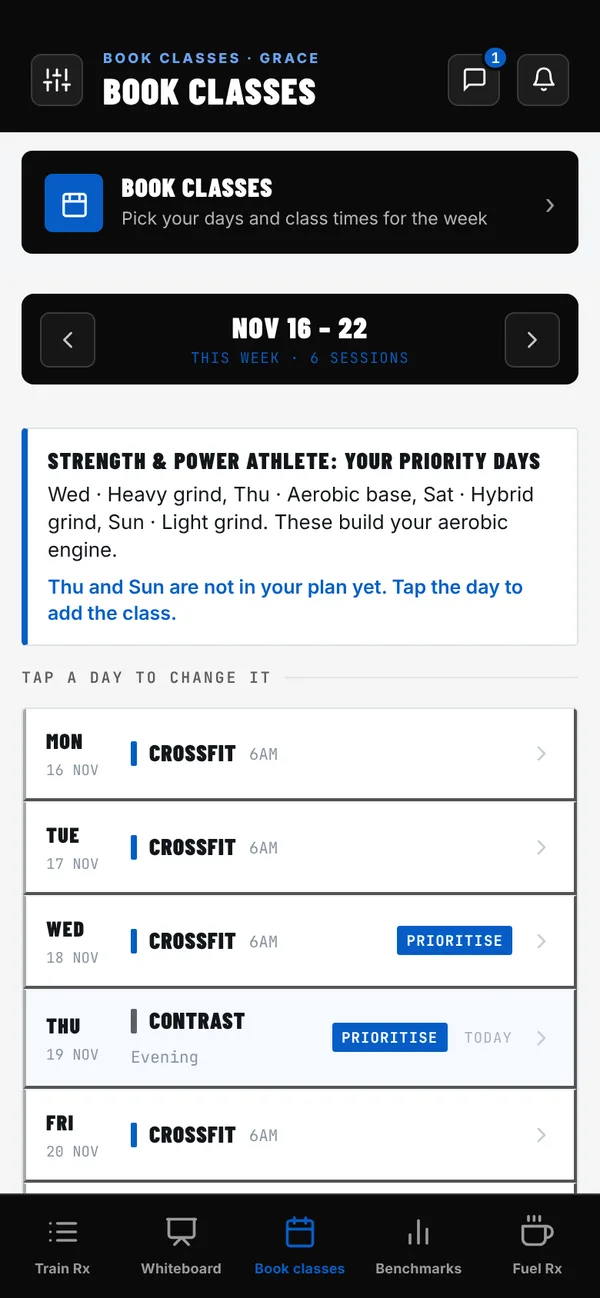 ABC
- Book the whole week in one go: days, then times.
- Your priority days, named. If one isn't in your plan, it tells you.
- Tap a day to change it. The priority tag stays on.
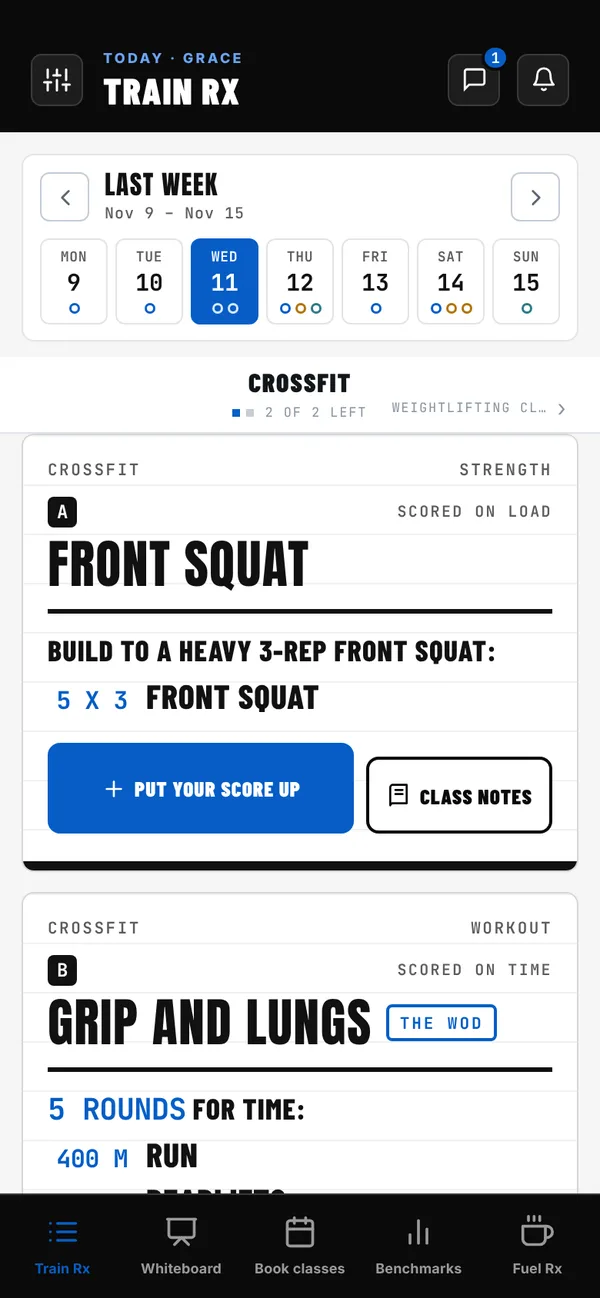 ABC
- Your week, a dot for every class booked.
- The day's workout, with what it's scored on.
- Class notes: what it's for, before you walk in.
Real screens from a test account on our app, for the week of 16 November. Missed a week? covers getting back on when a week falls over.
The best program in the world loses to the one you actually turn up to.Coach's note
You walk in knowing what today is for
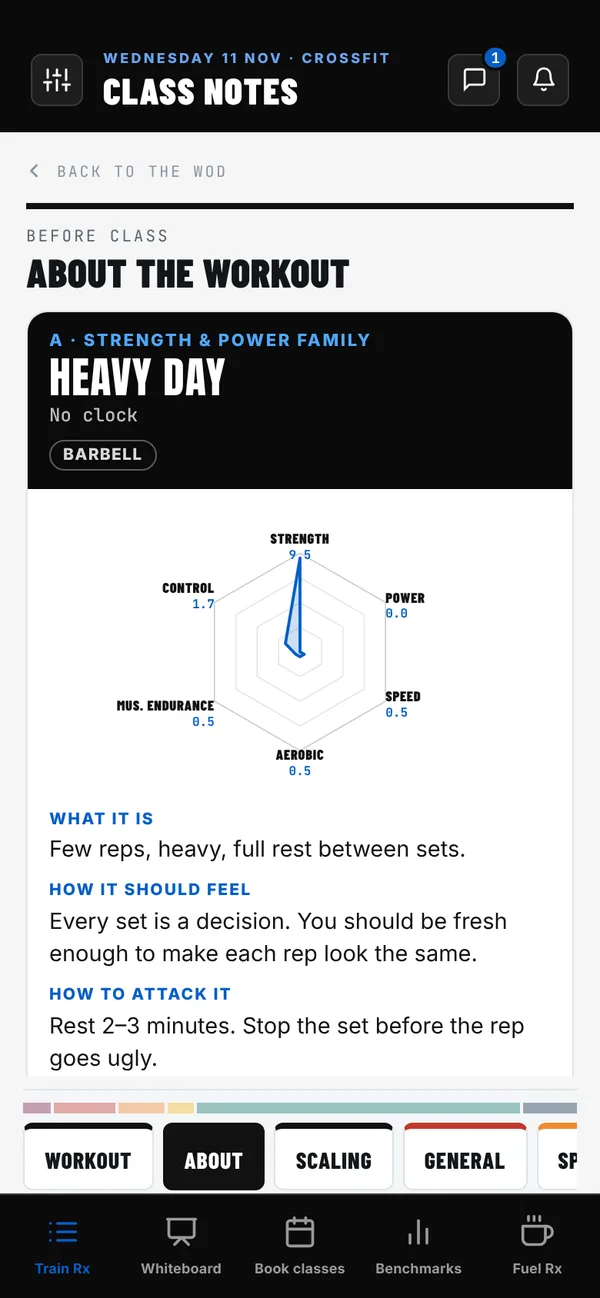
No standing at the whiteboard guessing. Every workout comes with Class notes: what type of day it is, what it trains, how it should feel, and the version for you. Read it in the car park.
 ABCD
A real Class notes screen from a test account, Wednesday 11 November. The web is drawn by our stimulus formula from the workout as written, read for someone doing it Rx'd.
A mum seven months postpartum and a dad who played footy at 25 do the same workout at very different weights, and both get the training effect. The coach scales it, swaps what annoys your knee, and tells you when to go heavier.
"I feel fitter" is nice. A number is better.
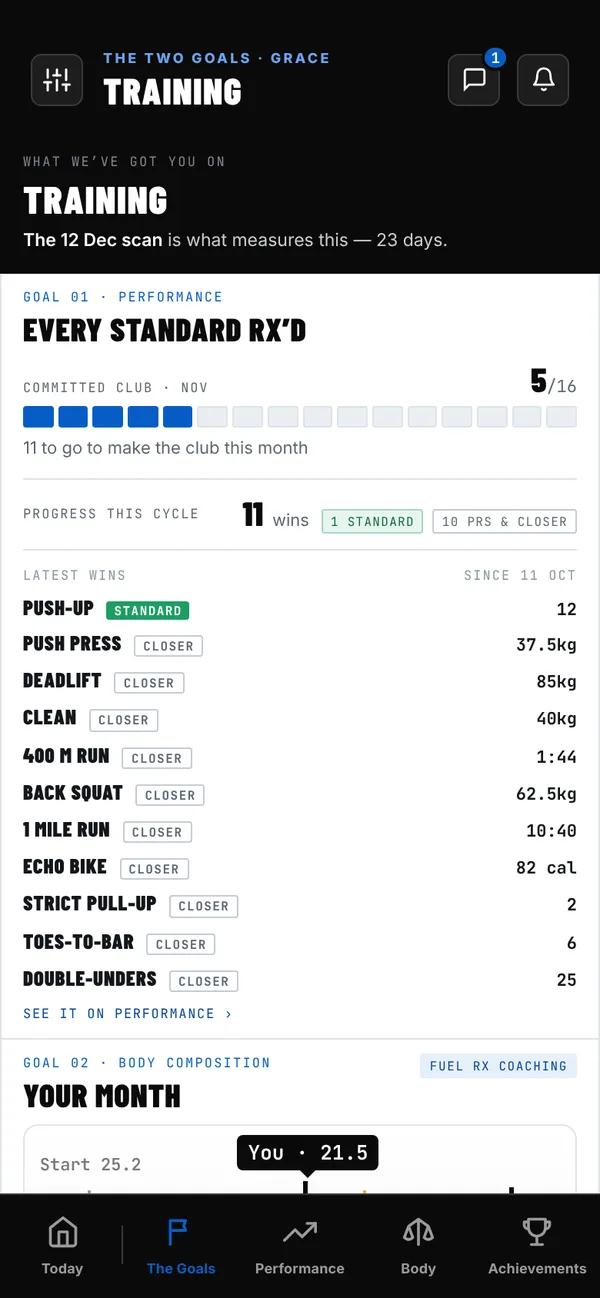
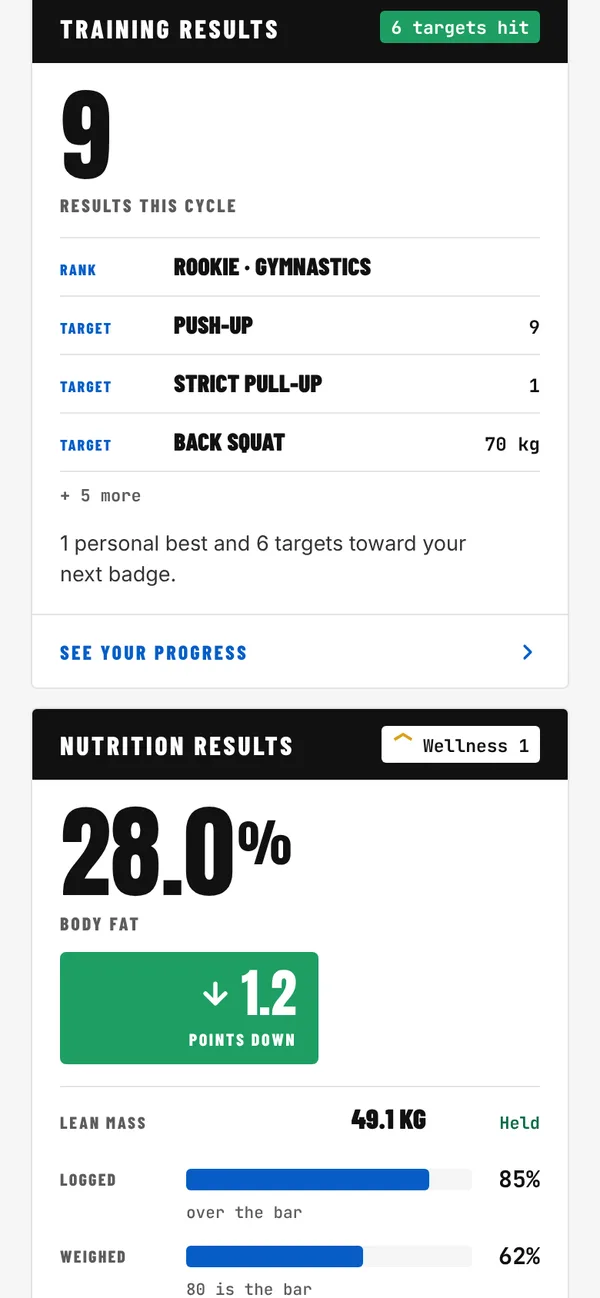
At your intro we scan you and set two goals. At Day 30 and every 60 days after, we rescan and retest, and you see exactly what moved: fat, muscle, your lifts.
 ABC
- The date of your next scan, counting down.
- The Committed Club: 16 coached classes a month.
- Every win since your last check-in.
 ABC
- Results this cycle, counted.
- Your rank and the targets you hit.
- The Fuel Rx half, on the same page.
Your goals is a real screen from a test account; the report is the app's sample member, made up so every block shows. Your report fills in from your own check-ins.
The habit underneath it all is turning up: the Committed Club is 16 coached classes a month, about four a week. That's your four hours.
All six, balanced, in about four hours a week. Hard, but your version of hard. A coach on the floor and a room that notices when you don't show. Your week written every Sunday, booked in a minute, and measured every 60 days.
"Isn't CrossFit dangerous? Isn't it too intense for me?"
Fair question. Here's the honest answer.
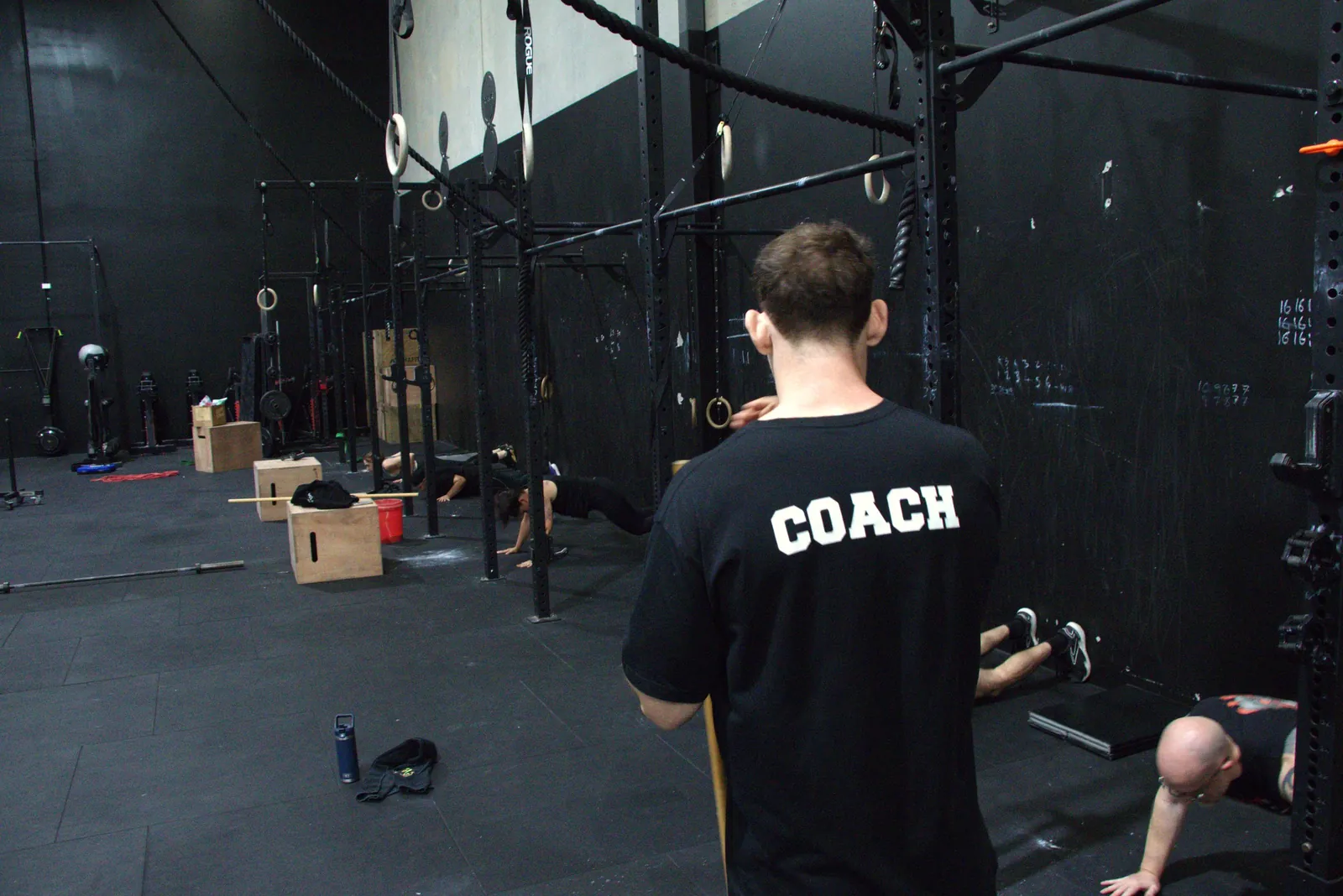
The injury risk is about the same as other sport, similar to or lower than weightlifting, distance running, rugby and gymnastics, and injuries were more common where nobody supervised.12 In a survey of 386 CrossFit athletes, injury rates were lower where trainers coached form and guided the workout.13 That's why every class here is coached, start to finish.
Intense means intense for you. Every workout has an Rx, an Intermediate and a Beginner version, built for the same stimulus. Before your first class you learn the core movements one-on-one in Fundamentals. Back, knees, pelvic floor, a niggle: tell your coach. We train around it, not into it.
The questions we get asked most
Tap a question to open it.
I've got kids. When do parents here actually train?
5AM and 6AM before the house wakes, 9:30AM after drop-off, 4PM, 5PM and 6PM after work, and Saturday 6AM and 8AM. And we're kid friendly: bring them, they hang out in an area close by, and you can get to them any time.
I already do yoga, or I already run. Do I still need this?
Keep it if you love it. It's covering one or two of the six, and doing it well. Train Rx fills in the rest, so your yoga or your run becomes a bonus, not the only thing holding you up. Tell your coach what else you do and we'll balance your week around it.
Do I need to do extra mobility at home?
No. Control is trained in every class: the warm-up, the positions your coach fixes, and the single-leg, overhead and gymnastics pieces in the week. If a physio has given you exercises, keep doing them and tell your coach, and we'll train around them.
I'm not fit enough to start. Shouldn't I get fit first?
No. You get fit by starting. Your first session is Fundamentals with a coach, and every workout after it has a Beginner version written for you.
Will lifting make me bulky?
Not by accident. A lot of muscle takes years of training and eating for it. For most people, strength training means firmer, stronger and harder to injure. Fuel Rx decides what your body is made of.
I'm over 40. Is it still right for me?
It's more right for you. Strength and engine work matter more with every decade, and the scaling is the same for everyone. Training over 40 covers what changes.
Does Train Rx cost extra?
No. Train Rx and Fuel Rx are both part of every membership.
The research
- Glassman G. What is fitness? The CrossFit Journal 2002 (October).
- Westcott WL. Resistance training is medicine: effects of strength training on health. Current Sports Medicine Reports 2012;11(4):209–216.
- Weston KS, Wisløff U, Coombes JS. High-intensity interval training in patients with lifestyle-induced cardiometabolic disease: a systematic review and meta-analysis. British Journal of Sports Medicine 2014;48(16):1227–1234.
- Mandsager K, Harb S, Cremer P, Phelan D, Nissen SE, Jaber W. Association of cardiorespiratory fitness with long-term mortality among adults undergoing exercise treadmill testing. JAMA Network Open 2018;1(6):e183605.
- Garber CE, Blissmer B, Deschenes MR, et al. American College of Sports Medicine position stand. Quantity and quality of exercise for developing and maintaining cardiorespiratory, musculoskeletal, and neuromotor fitness in apparently healthy adults: guidance for prescribing exercise. Medicine & Science in Sports & Exercise 2011;43(7):1334–1359.
- Schumann M, Feuerbacher JF, Sünkeler M, et al. Compatibility of concurrent aerobic and strength training for skeletal muscle size and function: an updated systematic review and meta-analysis. Sports Medicine 2022;52(3):601–612.
- Schoenfeld BJ, Ogborn D, Krieger JW. Effects of resistance training frequency on measures of muscle hypertrophy: a systematic review and meta-analysis. Sports Medicine 2016;46(11):1689–1697.
- Bull FC, Al-Ansari SS, Biddle S, et al. World Health Organization 2020 guidelines on physical activity and sedentary behaviour. British Journal of Sports Medicine 2020;54(24):1451–1462.
- Mazzetti SA, Kraemer WJ, Volek JS, et al. The influence of direct supervision of resistance training on strength performance. Medicine & Science in Sports & Exercise 2000;32(6):1175–1184.
- Lacroix A, Hortobágyi T, Beurskens R, Granacher U. Effects of supervised vs. unsupervised training programs on balance and muscle strength in older adults: a systematic review and meta-analysis. Sports Medicine 2017;47(11):2341–2361.
- Burke SM, Carron AV, Eys MA, Ntoumanis N, Estabrooks PA. Group versus individual approach? A meta-analysis of the effectiveness of interventions to promote physical activity. Sport & Exercise Psychology Review 2006;2(1):19–35.
- Klimek C, Ashbeck C, Brook AJ, Durall C. Are injuries more common with CrossFit training than other forms of exercise? Journal of Sport Rehabilitation 2018;27(3):295–299.
- Weisenthal BM, Beck CA, Maloney MD, DeHaven KE, Giordano BD. Injury rate and patterns among CrossFit athletes. Orthopaedic Journal of Sports Medicine 2014;2(4):2325967114531177.